
When routine blood tests display low hemoglobin alongside an elevated Mean Corpuscular Volume (MCV > 100 fL), patients are often perplexed—especially those who regularly consume meat and fish. Even more confounding are the coexisting symptoms: peripheral numbness or tingling in the fingers and toes, unsteadiness when walking, cognitive fog, or inexplicable low mood.
Behind these seemingly disparate manifestations lies the most structurally complex, heavy-metal-containing molecule among all essential nutrients: Vitamin B12 (Cobalamin).
In human physiology, B12 carries two non-negotiable responsibilities: erythropoietic maturation in bone marrow and the synthesis of myelin sheaths protecting central and peripheral nerves. Uniquely, its assimilation through the human gastrointestinal tract is an intricate, multi-stage obstacle course where any digestive breakdown can prevent absorption.
This guide explores the biochemical mechanism of B12 in red blood cell synthesis, outlines accessible food sources, and examines malabsorption conditions and pharmaceutical forms.
1. The Symphony of Bone Marrow: How Vitamin B12 Drives Red Blood Cell Maturation
To maintain optimal oxygenation across all tissues, bone marrow stem cells require an uninterrupted supply of DNA precursors to sustain high-frequency mitosis. Vitamin B12 serves as an indispensable coenzyme in this assembly line.
Methyl Transfer and Nucleotide Synthesis
Within the cellular cytoplasm, vitamin B12 acts as Methylcobalamin, binding directly to the enzyme Methionine Synthase:
- Releasing Trapped Folate: Methylcobalamin accepts a methyl group from 5-methyltetrahydrofolate (5-MTHF), converting it back into biologically active tetrahydrofolate (THF). Only when THF is available can bone marrow cells synthesize thymidine, the fundamental DNA building block.
- Neutralizing Vascular Toxins: By acquiring this methyl group, B12 simultaneously remethylates the vascular toxin Homocysteine into the essential amino acid Methionine, fueling the production of S-adenosylmethionine (SAMe), the universal methyl donor.
The Consequences of Deficiency: Megaloblastic Anemia and Neuropathy
When systemic B12 stores run dry, two physiological crises erupt:
- Erythropoietic Arrest and Intramedullary Hemolysis: Without B12, folate is immobilized within the “folate trap.” Erythroblasts cannot replicate their genomes to complete mitotic division; yet, cytoplasmic protein synthesis continues unchecked. The resulting oversized, dysplastic cells (“megaloblasts”) cannot exit the bone marrow and lyse prematurely. The few enlarged erythrocytes (MCV > 100 fL) that reach the bloodstream are fragile and short-lived, causing profound fatigue, pallor, and mild jaundice.
- Demyelinating Neuropathy: B12 is also an obligate cofactor in mitochondria for Methylmalonyl-CoA Mutase. Its absence triggers an accumulation of methylmalonic acid (MMA), which directly degrades the protective Myelin Sheath insulating neural axons. Patients experience symmetric “glove-and-stocking” paresthesia, loss of proprioception, ataxia, and in severe untreated cases, irreversible Subacute Combined Degeneration of the spinal cord.
2. Accessible Food Sources: The Best Natural Sources of Vitamin B12
Unlike folate, which is synthesized widely throughout plant tissues, vitamin B12 in nature is produced exclusively by specific bacteria and archaea. Animals obtain B12 through intestinal bacterial synthesis, microbial ingestion, or food chain bioaccumulation. Consequently, natural dietary B12 is concentrated almost entirely in animal-derived foods.
The Recommended Dietary Allowance (RDA) for healthy adults is 2.4 micrograms (mcg) per day. Meeting this target is straightforward with strategic dietary selections.
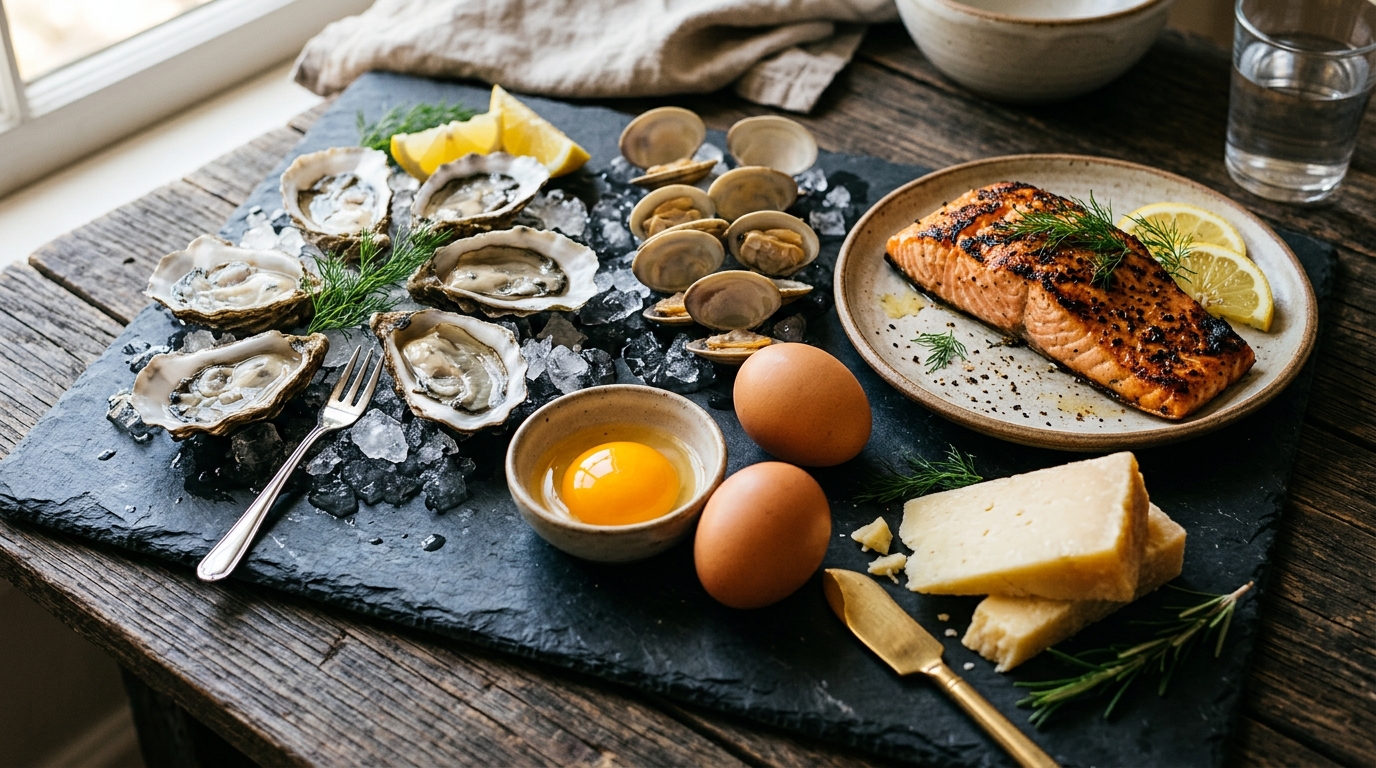
1. Shellfish and Bivalves (Accessibility: High)
Bivalve mollusks offer the highest natural concentration of B12 on Earth:
- Clams and Cockles: 100g of cooked clams delivers an astounding 80–90 mcg of B12. Eating just 3 to 4 clams provides many times the entire daily requirement for an adult.
- Oysters and Mussels: 100g of steamed mussels or oysters provides 15–20 mcg of B12, alongside rich stores of bioavailable zinc and iron to support blood volume.
2. Oily Fish and Salmon (Accessibility: High)
Widely available in supermarkets and fish markets:
- Mackerel: Yields 12–19 mcg of B12 per 100g. A single grilled fillet easily satisfies several days of baseline requirements while providing anti-inflammatory Omega-3 fatty acids.
- Sardines, Saury, and Wild Salmon: Fresh saury and sardines contain 8–12 mcg per 100g, while wild salmon supplies 3–5 mcg per 100g in tender, easily digestible protein.
3. Poultry, Red Meat, and Organ Meats (Accessibility: High)
- Liver (Beef, Pork, Chicken): The liver is the primary physiological reservoir of B12 in mammals; 100g of beef liver contains over 60 mcg of B12.
- Lean Beef and Lamb: Supplies 2–3 mcg per 100g alongside highly absorbable heme iron.
4. Eggs and Dairy Products (Accessibility: High)
Crucial daily staples for lacto-ovo vegetarians:
- Egg Yolks: One whole large egg provides approximately 0.6–0.9 mcg of B12, concentrated predominantly in the yolk.
- Cheese, Yogurt, and Fresh Milk: A 240ml glass of whole milk delivers around 1.2 mcg of B12; aged cheddar or parmesan supplies 1.5–3 mcg per 100g.
5. Safe Pathways for Strict Vegans (Accessibility: Moderate)
Because plants do not synthesize cobalamin, strict vegans must rely on fortified sources or supplements:
- Fortified Nutritional Yeast: Yellow, savory flakes packed with B vitamins. Just one teaspoon (approx. 5g) of fortified yeast supplies several micrograms of bioavailable B12—ideal for sprinkling over soups, salads, and pasta.
- Fortified Plant Milks and Breakfast Cereals: Verify packaging labels for added cyanocobalamin or methylcobalamin.
3. Gastrointestinal Physiology: The Vulnerable Multi-Stage Absorption Cascade
Many patients consume sufficient meat yet test severely deficient in serum B12. This stems from the fact that B12 absorption requires an intact, sequential gastrointestinal pathway:
- Gastric Acid Dissociation: In the stomach, adequate hydrochloric acid and pepsin must cleave B12 from dietary animal proteins.
- R-Protein Protection: Free B12 binds to haptocorrin (R-protein) secreted in saliva, protecting it from degradation in acidic gastric juice.
- Intrinsic Factor (IF) Binding: Parietal cells in the gastric lining secrete Intrinsic Factor. In the duodenum, pancreatic proteases degrade the R-protein, allowing B12 to bind tightly with Intrinsic Factor.
- Terminal Ileal Receptor Uptake: The B12-IF complex travels through the small intestine to the terminal ileum, where specialized mucosal receptors (Cubilin-Amnionless complex) facilitate receptor-mediated endocytosis into portal circulation.
High-Risk Populations for Malabsorption
Any pathology disrupting this chain leads to functional deficiency:
- Long-term Antacid or PPI Use: Proton pump inhibitors suppress gastric acid, preventing B12 cleavage from food proteins.
- Atrophic Gastritis in Older Adults: Gastric mucosal thinning diminishes hydrochloric acid and intrinsic factor secretion in up to 30% of seniors.
- Pernicious Anemia: An autoimmune condition where autoantibodies destroy gastric parietal cells or block intrinsic factor.
- Metformin Therapy: Chronic use in type 2 diabetes impairs ileal membrane calcium-dependent receptor function in 10%–30% of patients.
- Bariatric and Gastrointestinal Surgeries: Gastrectomy, gastric bypass, or resection of the terminal ileum eliminates the necessary anatomy for absorption.
4. Comparing Supplemental Forms of Vitamin B12
When diet alone is insufficient, supplements offer distinct molecular forms of cobalamin:
| Form | Chemical Profile | Clinical Characteristics |
|---|---|---|
| Methylcobalamin | Active Coenzyme | Directly utilized in the cytoplasm for homocysteine remethylation and bone marrow erythropoiesis; high affinity for peripheral nerve regeneration. |
| Adenosylcobalamin | Active Coenzyme | Mitochondrial form required for the metabolism of branched-chain amino acids and fatty acids, supporting cellular energy and myelin lipids. |
| Cyanocobalamin | Synthetic | Highly stable and cost-effective. Requires hepatic decyanation before cellular use. Not recommended in heavy smokers or end-stage renal failure. |
| Hydroxocobalamin | Natural Microbial | Exhibits prolonged plasma half-life and superior tissue retention; commonly used in injectable clinical protocols and cyanide toxicity rescue. |
Practical Supplementation Advice
- High-Dose Oral Therapy (Passive Diffusion): Even when intrinsic factor is absent, approximately 1% to 2% of an oral dose is absorbed via non-receptor passive diffusion. Doses of 1,000 to 2,000 mcg daily can successfully overcome absorption barriers.
- Sublingual Lozenges: Allow direct mucosal absorption through sublingual capillaries, bypassing gastric acidity issues.
- Intramuscular Injections: For severe neuropathy, post-gastrectomy patients, or pernicious anemia, intramuscular injections bypass the entire gastrointestinal tract to restore cellular reserves rapidly.
Support Independent Perspectives & In-Depth Insights
Every thoughtful analysis and candid critique comes from our dedication to truth and quality. We choose not to follow sensational algorithms or clickbait headlines.
Sustaining independent research requires reader support. Make a one-time or monthly contribution, securely processed by Google.
Payments secured by Google · Manage or cancel anytime in your Google Account



Comments