
Many people experience persistent daytime fatigue, shortness of breath on stairs, morning lightheadedness, or pale lips and skin. The default reaction is often to assume “iron deficiency anemia” and immediately take iron supplements. Yet, for many individuals, blood tests reveal that hemoglobin remains depressed or that red blood cells are abnormally enlarged despite ample iron intake.
In reality, the body’s primary blood factory—the bone marrow—requires far more than iron to continuously churn out healthy, oxygen-rich red blood cells. A vital and irreplaceable catalytic cofactor in this cellular assembly line is Folate (Vitamin B9).
Far from being solely a “prenatal supplement for pregnant women,” folate is the fundamental currency of all rapidly dividing cells throughout the human body. From DNA duplication to erythrocyte maturation, folate operates around the clock.
How does folate orchestrate hematopoiesis in the bone marrow? What everyday dietary staples provide the highest concentrations? And what are the crucial biochemical distinctions between synthetic folic acid, active 5-MTHF, and genetic metabolic roadblocks?
1. The Engine of Hematopoiesis: Why Bone Marrow Demands Folate
Every second, human bone marrow must manufacture upwards of two million brand-new red blood cells to replace aging erythrocytes and sustain vital oxygen delivery across organ systems.
DNA Synthesis and the Mechanism of Cell Division
Within the hematological niche of bone marrow, hematopoietic stem cells undergo successive mitotic divisions, transitioning through proerythroblasts and normoblasts before enucleating into mature biconcave red blood cells (measuring 7–8 micrometers in diameter).
Every mitotic round necessitates the faithful replication of the entire cellular genome. Among the four nucleotide building blocks of DNA (A, T, C, G), the de novo synthesis of Thymidine (the “T” base) depends strictly on active tetrahydrofolate acting as a one-carbon methyl donor.
When systemic folate reserves are depleted:
- Arrested DNA Replication: Without adequate thymidine, nuclear chromosomes cannot duplicate, arresting the cellular cycle during the DNA synthesis (S) phase.
- Nuclear-Cytoplasmic Dyssynchrony: While the nucleus is stranded and unable to divide, RNA synthesis and hemoglobin production in the cytoplasm continue unabated.
- Megaloblastic Anemia: Erythroblasts swell into fragile, oversized “megaloblasts.” The bone marrow cannot release these distorted cells normally; vast numbers undergo intramedullary destruction (ineffective erythropoiesis). The few abnormal cells that escape into the peripheral bloodstream exhibit a high Mean Corpuscular Volume (MCV > 100 fL) with severely shortened lifespans, triggering severe systemic tissue hypoxia.
2. Accessible Food Sources: The Best Everyday Dietary Folate
The human body cannot synthesize folate de novo, and as a water-soluble micronutrient, storage in the liver is relatively modest (roughly 5–10 mg, sufficient for only a few months). Fortunately, natural foods offer abundant folate stores.
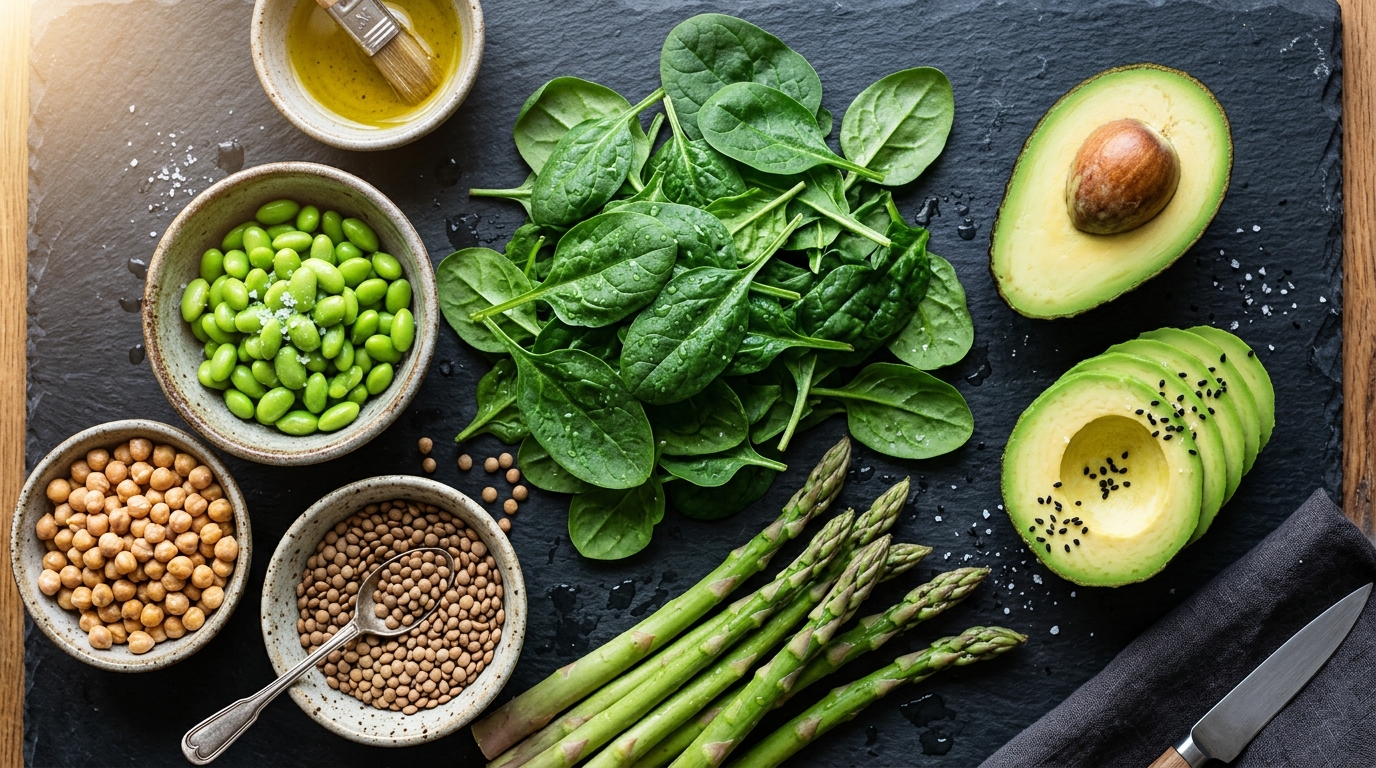
Folate was first isolated by scientists in 1941 from dark spinach leaves; its Latin etymology folium literally translates to “leaf.” Leafy greens represent the most intuitive, everyday vehicle for nutritional replenishment.
1. Dark Leafy Greens (Accessibility: High)
Dark green vegetables offer the highest folate density in everyday home cooking:
- Spinach: Provides approximately 140–190 mcg of folate per 100g. A single cooked serving supplies nearly half of the recommended daily intake for adults (400 mcg).
- Asparagus: Packs around 150 mcg per 100g, along with asparagine to support metabolic vitality.
- Broccoli: Delivers 60–120 mcg per 100g, complemented by abundant vitamin C that enhances non-heme iron absorption.
- Kale, Bok Choy, and Mustard Greens: Readily available at local produce markets, each offering substantial natural folate.
2. Legumes and Pulses (Accessibility: High)
Legumes represent the unsung champions of botanical folate:
- Edamame: Fresh young soybeans contain an impressive 250–300 mcg of folate per 100g, making them an accessible, wholesome snack.
- Chickpeas, Lentils, and Black Beans: One cup of cooked chickpeas or lentils (approx. 150g) delivers over 200 mcg of folate alongside high-quality plant-based protein.
3. Fresh Fruits, Seeds, and Nuts (Accessibility: Moderate)
Consuming raw fruits and nuts eliminates the risk of cooking-induced thermal degradation:
- Avocado: Half an avocado contributes around 60 mcg of folate, paired with healthy monounsaturated fatty acids.
- Citrus Fruits (Oranges, Grapefruits, Mandarins): One medium orange yields 40–50 mcg of folate alongside bioflavonoids.
- Papaya and Guava: Tropical fruits with high micronutrient profiles; a cup of fresh papaya provides roughly 50 mcg of folate.
- Sunflower Seeds, Pumpkin Seeds, and Walnuts: A daily handful of raw nuts delivers 20–30 mcg of folate plus essential trace minerals like copper and zinc.
4. Organ Meats: The Animal Kingdom’s Nutritional Powerhouse (Accessibility: Moderate)
- Liver (Chicken, Beef, Pork): 100g of cooked chicken liver delivers an astounding 700+ mcg of folate, accompanied by bioavailable heme iron and vitamin B12.
- Culinary Note: Consuming organ meats 1–2 times per week (approx. 50–80g per serving) is sufficient, avoiding excessive preformed vitamin A intake.
3. The Biochemical Reality: Synthetic Folic Acid vs. Active 5-MTHF
On supplement labels, consumers often encounter different terms: Folate, Folic Acid, and L-Methylfolate. These are biochemically distinct compounds.
- Natural Dietary Folate: Exists predominantly as polyglutamates. Intestinal enzymes hydrolyze these molecules into monoglutamate forms before absorption and reduction to tetrahydrofolate (THF).
- Synthetic Folic Acid: A fully oxidized synthetic compound widely utilized in food fortification due to shelf stability. However, converting synthetic folic acid into usable THF requires the enzyme Dihydrofolate Reductase (DHFR) in the liver. In humans, hepatic DHFR exhibits notoriously sluggish activity; single doses above 200–400 mcg often lead to detectable levels of Unmetabolized Folic Acid (UMFA) in systemic circulation.
The MTHFR Gene Polymorphism
To become biologically active within bone marrow cells, all folate intermediates must be converted by the enzyme Methylenetetrahydrofolate Reductase (MTHFR) into 5-Methyltetrahydrofolate (5-MTHF).
A notable fraction of the global population carries genetic polymorphisms in the MTHFR gene (chiefly the C677T and A1298C variants):
- Homozygous C677T (TT Genotype): Exhibits a 60%–70% reduction in enzymatic conversion efficacy.
- Consequence: Individuals with this genetic profile struggle to convert standard synthetic folic acid into active 5-MTHF. Consequently, red blood cell synthesis remains sluggish and homocysteine levels can rise, even when consuming fortified foods.
Direct Supplementation with L-Methylfolate (5-MTHF)
For those with reduced enzymatic efficiency or severe hematological demand, bioactive methylfolate (such as patented forms like Metafolin® or Quatrefolic®) bypasses both DHFR and MTHFR bottlenecks, entering the bloodstream directly to fuel bone marrow DNA synthesis.
4. Crucial Clinical Pitfall: The “Folate Trap” and Vitamin B12
In hematology, one foundational guideline is strictly observed: Never administer high-dose folate without first verifying vitamin B12 status.
This biochemical phenomenon is known as the Folate Trap:
- Intracellular 5-MTHF must donate its methyl group to vitamin B12 (forming methylcobalamin) in order to revert into tetrahydrofolate (THF).
- If vitamin B12 is deficient, cellular folate becomes permanently trapped in the 5-MTHF state, unable to regenerate THF for thymidine DNA synthesis.
- Supplying massive doses of synthetic folate can temporarily bypass this block and artificially correct anemia markers, but it leaves the neurological demyelination caused by B12 deficiency unchecked. Patients risk developing irreversible spinal cord degeneration (Subacute Combined Degeneration) while their blood counts falsely appear normal.
Support Independent Perspectives & In-Depth Insights
Every thoughtful analysis and candid critique comes from our dedication to truth and quality. We choose not to follow sensational algorithms or clickbait headlines.
Sustaining independent research requires reader support. Make a one-time or monthly contribution, securely processed by Google.
Payments secured by Google · Manage or cancel anytime in your Google Account



Comments