
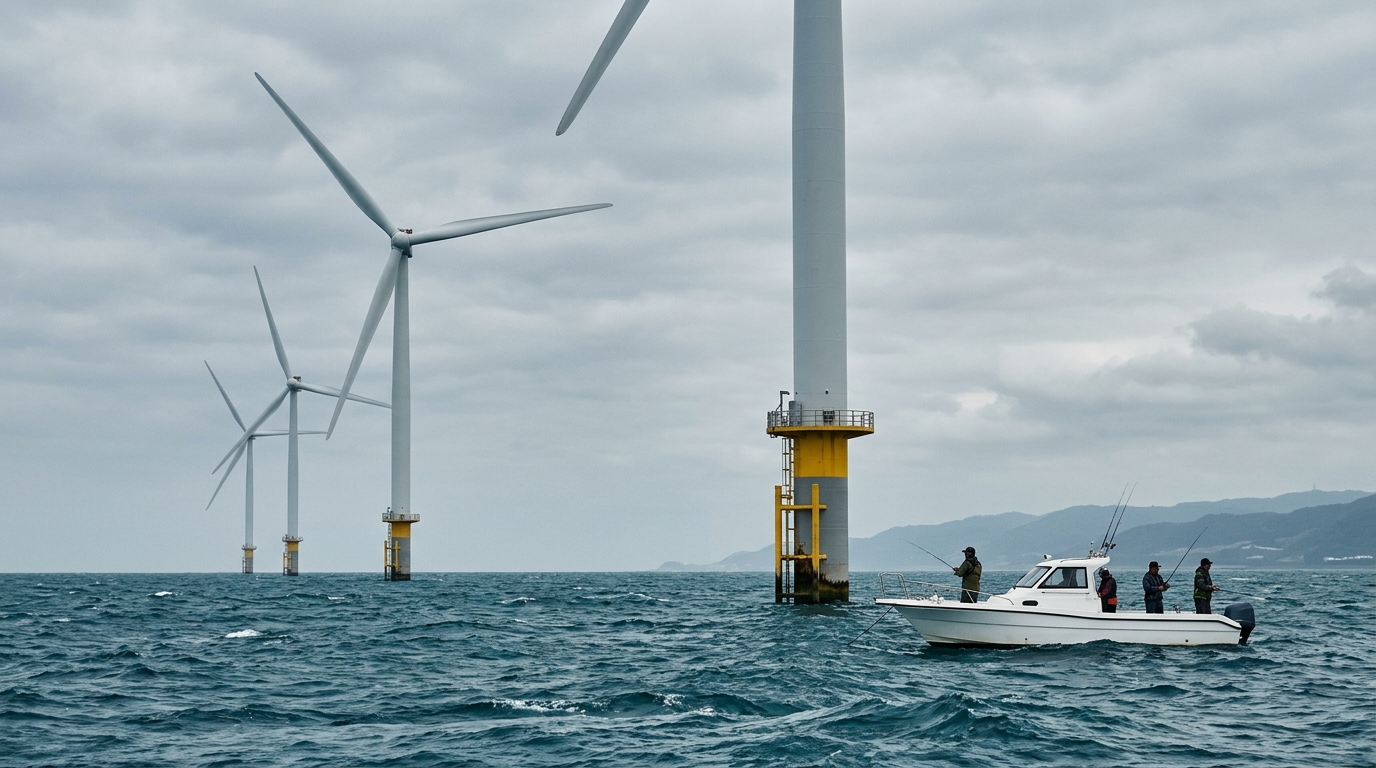
A recreational fishing boat anchors beneath a row of towering white turbines off Zhunan, Miaoli. The moment an angler’s metal jig hits the bottom, the rod tip jerks violently. Amberjack, blackhead seabream, and grouper come up one after another to cheers on deck. Back onshore, energy developers and PR teams are quick to circulate press releases framing the scene as a textbook win-win for “green energy and fisheries coexistence”—even spawning the absurd suggestion that if so many fish gather under turbines, we should plant turbines across the entire Taiwan Strait to restore the ocean.
This “seeing is believing” frenzy over packed coolers is classic survivorship bias. Equating fish aggregation with ecosystem health is like bulldozing a primary forest to build a mega-mall, seeing the food court packed on a Saturday afternoon, and declaring that concrete has successfully restored the local wildlife.
Decoding the Aggregation Spin: Artificial Reefs and No-Take Dividends
There really are fish around turbine foundations, but that stems from brute-force physical intervention—not an improving ecosystem.
Offshore wind farms become fishing hotspots for just two underlying reasons: the Fish Aggregating Device (FAD) effect and de facto fishing exclusion. Once multi-meter monopiles or jacket foundations are driven into the seabed, their submerged steel surfaces are rapidly colonized by barnacles, oysters, and algae. Small fish arrive to graze, drawing larger predators in behind them. In marine engineering, this is called aggregation, not production. Like a magnet, the steel columns pull dispersed biomass from surrounding waters into tight, predictable clusters—making it far easier for humans to harvest.
The even bigger variable is restricted fishing. To protect subsea cables and vessel safety, bottom trawling and large commercial fishing boats are barred from wind farm zones. Without trawlers scraping the seabed around the clock, almost any stretch of ocean will bounce back within three years. What anglers experience beneath the turbines is the regulatory dividend of halting industrial overfishing. The turbine is merely a steel boundary marker standing nearby—yet it gets credited with an ecological miracle it never performed.
Silent Ecological Disruption: Seabed Overwriting and Acoustic Filtering
Strip away the PR filter, and a harsh process of habitat replacement and sensory exclusion is unfolding underwater.
For tens of thousands of years, the natural baseline along the western coast of the Taiwan Strait—from Miaoli and Changhua down to Yunlin—has been a vast subtidal muddy-sand soft-bottom seabed. That ecosystem supports flatfish, tonguefish, lizardfish, crabs, shrimp, and countless burrowing invertebrates. When hundreds of massive steel piles and tons of rock scour protection are dropped onto the seafloor, that native soft-bottom habitat is crushed and permanently hardened. Native benthic species are forced out, replaced by organisms adapted to rocky reefs. It is a forced overwriting of an indigenous seascape by foreign hard structures—turning a prairie into a concrete jungle and celebrating the sudden boom in sparrows and rats.
Another invisible barrier comes from nonstop physical interference during turbine operation:
- Structure-borne low-frequency noise below 500 Hz: Mechanical energy from blades slicing the air and nacelle gearboxes travels straight down the steel monopiles into the water column and seabed, creating continuous low-frequency vibration and particle motion. Passive acoustic monitoring of Miaoli’s Formosa 1 wind farm by researchers from National Taiwan Ocean University and National Taiwan University has already shown that such noise suppresses the courtship choruses—both in frequency and acoustic power—of croakers (Sciaenidae), such as white croaker, yellow croaker, and blackmouth croaker. For fish that rely on sound to find mates, a wind farm is functionally deafening and silencing.
- Electromagnetic field (EMF) barriers from subsea cables: Energized inter-array and high-voltage export cables generate localized electromagnetic fields along the seabed, directly disrupting the electroreceptive navigation of cartilaginous fish like sharks and rays as well as demersal migratory species, forcing them to alter migration routes.
What stays behind for anglers to reel in are hardy, reef-preferring species that tolerate low-frequency rumble, do not rely on delicate acoustic signaling, and favor hard cover. Wind turbines act as an invisible biological sieve—flushing out sensitive native species while retaining high-tolerance generalists. The quality of biodiversity is distorted, masked behind a superficial illusion of abundance.
The Scientific Baseline: Aggregation vs. Net Production
The North Sea offers more than two decades of operational offshore wind data, and marine institutes in Belgium, Germany, and the Netherlands settled this “fishing boom” question long ago.
Studies show that over 80% of the apparent biomass increase around wind turbines reflects spatial redistribution, not net production across the broader marine ecosystem. In plain terms, fish are not reproducing more because turbines were installed; they have simply relocated beside the steel pillars. Worse, because fish concentrate tightly around fixed, known coordinates, opening those zones to recreational charters or targeted gear can accelerate localized stock depletion.
At the same time, localized wake effects created as foundations slice through ocean currents alter plankton and sediment distribution. Across an array of a hundred turbines, aerodynamic drag and underwater structural blockage combine to reduce bottom-water exchange rates. Those chronic hydrodynamic shifts never make it into viral clips of anglers hoisting full iceboxes.
An Honest Boundary for Energy’s Cost
Modern society needs electricity, and Taiwan’s semiconductor fabs and everyday air conditioners require green power certificates. Offshore wind carries undeniable strategic necessity.
In a heavily industrialized world, no energy source comes with zero environmental cost. To cut carbon and advance the energy transition, sacrificing a portion of western Taiwan’s native muddy-sand seabed in exchange for billions of kilowatt-hours of renewable power is an engineering trade-off that can be weighed openly on a balance sheet.
What truly leaves a sour taste is the cheap hypocrisy of exploiting the ocean while erecting an ecological halo—repackaging industrial “habitat hardening” and “species filtering” as marine restoration, or even arguing that we need more turbines to grow more fish. That leaves science behind altogether and crosses into Orwellian spin.
Conclusion
Fish crowding beneath offshore wind turbines are not singing praises to steel giants; they are adapting to survive after their native seabed was paved over and trawlers were fenced out. Acknowledging the ecological disruption and species filtering caused by green-energy infrastructure—and committing to rigorous, long-term acoustic and benthic monitoring—is the bare minimum of engineering honesty we owe the ocean.
Support Independent Perspectives & In-Depth Insights
Every thoughtful analysis and candid critique comes from our dedication to truth and quality. We choose not to follow sensational algorithms or clickbait headlines.
Sustaining independent research requires reader support. Make a one-time or monthly contribution, securely processed by Google.
Payments secured by Google · Manage or cancel anytime in your Google Account



Comments