
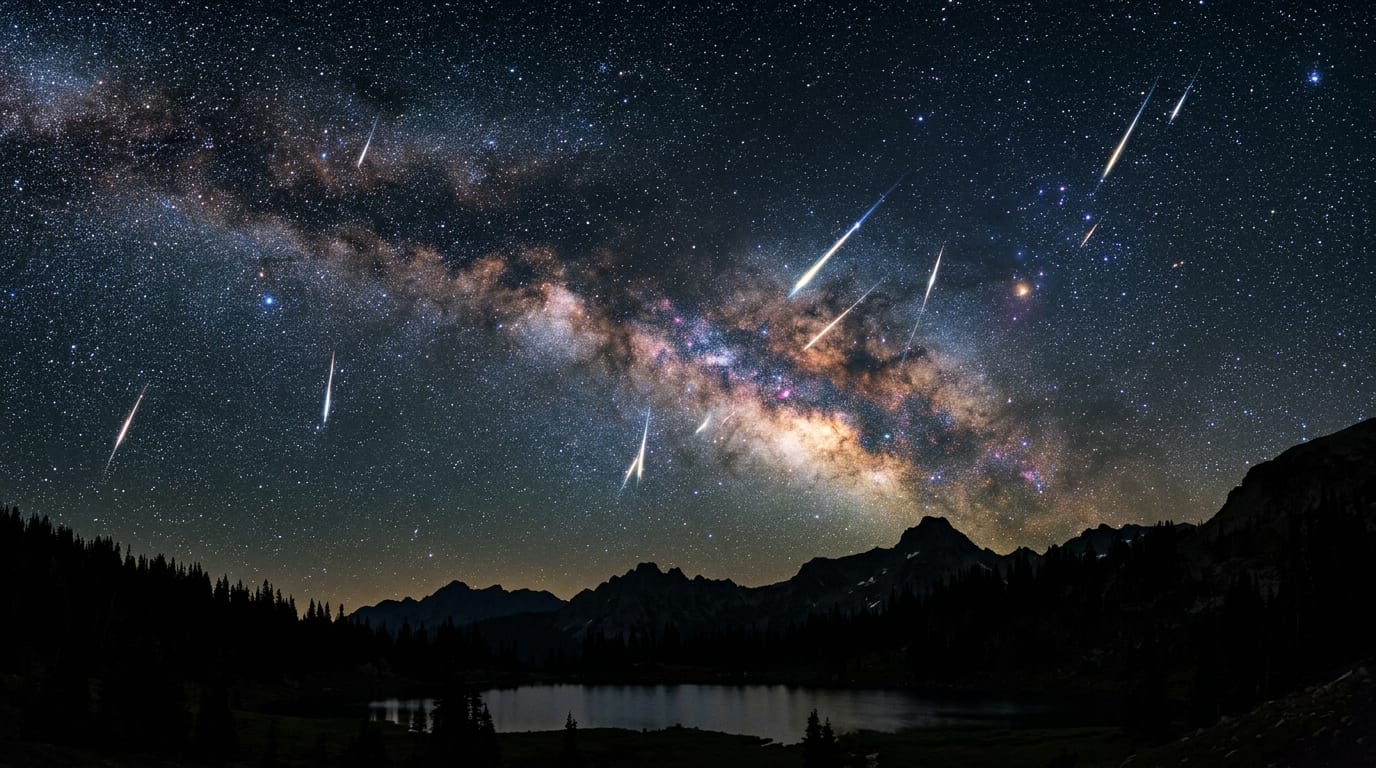
Gazing up into a quiet, starlit sky as brilliant streaks of light instantly slash across the darkness never fails to inspire awe and romantic wonder. For astronomy enthusiasts and stargazers alike, the regularly scheduled “Annual Big Three Meteor Showers”—the Quadrantids, Perseids, and Geminids—have long been unmissable celestial spectacles.
Yet beyond these high-profile marquee displays, long-term statistical observation records by the International Meteor Organization (IMO) reveal that there are as many as 32 meteor showers throughout the year across both hemispheres that are suitable for visual observation with the naked eye.
This comprehensive guide compiles detailed parameters and peak calendars for all 32 visually observable meteor showers worldwide, unpacks key astronomical metrics like Zenithal Hourly Rate (ZHR) and radiant coordinates, and provides field-tested stargazing and astrophotography tips.
The Rendezvous of Cosmic Dust: How Do Meteor Showers Form?
Meteors are not actual celestial stars falling from the sky; they are debris shed along the orbits of comets (or occasionally asteroids) traversing the Solar System:
- Cometary Dust Trails: As a comet nears the Sun, solar radiation vaporizes and sublimates surface ice, liberating billions of rocky fragments and dust particles along its orbital path and creating a meteoroid stream spanning hundreds of millions of kilometers.
- Earth Orbital Intersections: At predictable intervals each year, Earth’s orbital path intersects these dust streams, causing countless tiny particles to plunge into our upper atmosphere at speeds of dozens of kilometers per second.
- High-Temperature Ionization and Incandescence: As particles violently compress and create friction against atmospheric molecules, temperatures soar to thousands of degrees. Surrounding gases ionize and glow, tracing bright, fleeting trails across the night sky—what we observe from the ground as meteors.
Decoding Core Observational Parameters
When reading a meteor shower calendar, several foundational metrics help evaluate the viewing potential of a given night:
- Radiant:
Due to geometric perspective, all meteors belonging to the same stream appear to radiate outward from a single point in the sky. This celestial coordinate is represented by “Right Ascension (RA)” and “Declination (Dec),” and meteor showers are typically named after the constellation containing their radiant. - Zenithal Hourly Rate (ZHR):
The standardized benchmark for measuring a meteor shower’s activity. It represents the number of meteors a single observer would see per hour under ideal conditions (completely clear skies, zero light pollution, limiting stellar magnitude of +6.5, and the radiant positioned directly at the zenith). Under actual ground conditions, light pollution, horizon obstructions, and lower radiant altitudes typically reduce the observed rate to one-third to one-half of the theoretical ZHR. - Velocity (km/s):
The entry speed of particles penetrating the atmosphere. Slow meteors (such as the Draconids at ~20 km/s) drift across the sky gracefully, making them easy to spot; ultra-fast meteors (such as the Leonids reaching 71 km/s) blaze by in a fraction of a second but frequently leave behind ionized persistent trains that linger for seconds or even minutes. - Solar Longitude (λ⊙):
Earth’s orbital position around the Sun referenced to the J2000.0 vernal equinox. Because calendar leap years create minor date shifts, solar longitude pins down annual peak moments far more accurately than calendar dates.
Complete Calendar of 32 Visually Observable Meteor Showers
The following data is compiled from International Meteor Organization (IMO) observation guides, organized chronologically by peak activity date:
| Meteor Shower | Active Period | Peak Date | Solar Longitude (λ⊙) | Radiant RA | Radiant Dec | Velocity (km/s) | Peak ZHR |
|---|---|---|---|---|---|---|---|
| Quadrantids | 01/01 - 01/05 | 01/04 | 283°16’ | 230° | +49° | 41 | 120 |
| delta Centaurids | 01/28 - 02/21 | 02/09 | 319°02’ | 211° | -59° | 56 | 5 |
| delta Leonids | 02/15 - 03/22 | 02/25 | 336°00’ | 168° | +16° | 23 | 2 |
| gamma Normids | 02/25 - 03/22 | 03/13 | 353°00’ | 239° | -50° | 56 | 4 |
| Lyrids | 04/16 - 04/25 | 04/22 | 032°32’ | 271° | +34° | 49 | 18 |
| pi Puppids | 04/15 - 04/28 | 04/23 | 033°05’ | 110° | -45° | 18 | Variable (Var) |
| eta Aquariids | 04/19 - 05/28 | 05/06 | 045°05’ | 338° | -01° | 66 | 70+ |
| eta Lyrids | 05/03 - 05/12 | 05/09 | 048°04’ | 287° | +44° | 44 | 3 |
| June Boötids | 06/22 - 07/02 | 06/27 | 095°07’ | 224° | +48° | 18 | Variable (Var) |
| Piscis Austrinids | 07/15 - 08/10 | 07/27 | 125°00’ | 341° | -30° | 35 | 5 |
| Southern delta Aquariids | 07/12 - 08/19 | 07/27 | 125°00’ | 339° | -16° | 41 | 20 |
| alpha Capricornids | 07/03 - 08/15 | 07/29 | 127°00’ | 307° | -10° | 23 | 4 |
| Perseids | 07/17 - 08/24 | 08/12 | 140°00’ | 46° | +58° | 59 | 100 |
| kappa Cygnids | 08/03 - 08/25 | 08/17 | 145°00’ | 286° | +59° | 25 | 3 |
| alpha Aurigids | 08/25 - 09/08 | 09/01 | 158°06’ | 84° | +42° | 66 | 7 |
| September Perseids | 09/05 - 09/17 | 09/09 | 166°07’ | 60° | +47° | 64 | 5 |
| delta Aurigids | 09/18 - 10/10 | 09/28 | 191°00’ | 88° | +49° | 64 | 3 |
| Draconids | 10/06 - 10/10 | 10/08 | 195°04’ | 262° | +54° | 20 | Variable (Var) |
| epsilon Geminids | 10/14 - 10/27 | 10/18 | 205°00’ | 102° | +27° | 70 | 2 |
| Orionids | 10/02 - 11/07 | 10/21 | 208°00’ | 95° | +16° | 66 | 30 |
| Leo Minorids | 10/19 - 10/27 | 10/24 | 211°00’ | 162° | +37° | 62 | 2 |
| Southern Taurids | 09/25 - 11/25 | 11/05 | 223°00’ | 52° | +15° | 27 | 5 |
| Northern Taurids | 09/25 - 11/25 | 11/12 | 230°00’ | 58° | +22° | 29 | 5 |
| Leonids | 11/10 - 11/23 | 11/17 | 235°27’ | 153° | +22° | 71 | 20+ |
| alpha Monocerotids | 11/15 - 11/25 | 11/21 | 239°32’ | 117° | +01° | 65 | Variable (Var) |
| December Phoenicids | 11/28 - 12/09 | 12/06 | 254°25’ | 18° | -53° | 18 | Variable (Var) |
| Puppid-Velids | 12/01 - 12/15 | 12/06 | 255°00’ | 123° | -45° | 40 | 10 |
| Monocerotids | 11/27 - 12/17 | 12/08 | 257°00’ | 100° | +08° | 42 | 2 |
| sigma Hydrids | 12/03 - 12/15 | 12/11 | 260°00’ | 127° | +02° | 58 | 3 |
| Geminids | 12/07 - 12/17 | 12/13 | 262°02’ | 112° | +33° | 35 | 120 |
| Coma Berenicids | 12/12 - 01/23 | 12/20 | 268°00’ | 177° | +25° | 65 | 5 |
| Ursids | 12/17 - 12/26 | 12/22 | 270°07’ | 217° | +76° | 33 | 10 |
Reference Notes:
- Solar Longitude Baseline: Referenced to the J2000.0 astronomical epoch.
- Variable (Var): Denotes showers whose activity can fluctuate drastically. While quiescent years may yield only a few sporadic meteors, perihelion cometary returns or dense filament passages can trigger intense, short-lived meteor storms.
Practical Stargazing Tips: Maximizing Your Meteor Sightings
You do not need an expensive high-powered telescope to enjoy meteor showers. In fact, the “naked eye” is actually your best observation tool! Telescopes drastically constrain field of view, making you far more likely to miss meteors streaking across random quadrants of the sky. To get the best experience, keep three core rules in mind:
- Choose Dark Skies with Unobstructed Vistas
Distance yourself from urban light domes, neon signs, and streetlamps. High-altitude mountains, national parks, and remote coastlines make prime observation grounds. Pick spots free from mountain shadows or towering tree canopies that offer wide-open horizons. - Monitor Moon Phases
Bright moonlight from full or near-full moons is the single biggest impediment to stargazing. When planning meteor observations, favor years where peak dates coincide with the new moon or waxing/waning crescent phases. If the Moon is up, schedule sessions before moonrise or after moonset. - Allow Dark Adaptation and Pack Warm Layers
Give your eyes 20 to 30 minutes in total darkness after arriving at your observation site. As pupils dilate, you will spot fainter meteors. Use flashlights wrapped in red cellophane to prevent white light from ruining night vision. Mountain temperatures drop sharply at night, so bring windproof clothing, insulated sleeping mats, or reclining camp chairs to watch comfortably while lying back.
Astrophotography Tips: Capturing Meteor Trails
To capture meteor showers with a DSLR or mirrorless camera:
- Fast Wide-Angle Lens: Use a focal length under 24mm with an aperture of f/2.8 or faster.
- Sturdy Tripod: A heavy-duty tripod and shutter release cable (or intervalometer) are indispensable for long exposures.
- Exposure Settings: Set manual focus (MF) to infinity, ISO between 1600 and 6400, and shutter speed between 15 and 30 seconds.
- Continuous Interval Shooting: Run an intervalometer for several hours continuously, and later use astrophotography stacking software to composite individual frames containing meteor streaks into a single radiant starburst image!
Recommended Reading
Support Independent Perspectives & In-Depth Insights
Every thoughtful analysis and candid critique comes from our dedication to truth and quality. We choose not to follow sensational algorithms or clickbait headlines.
Sustaining independent research requires reader support. Make a one-time or monthly contribution, securely processed by Google.
Payments secured by Google · Manage or cancel anytime in your Google Account



Comments