
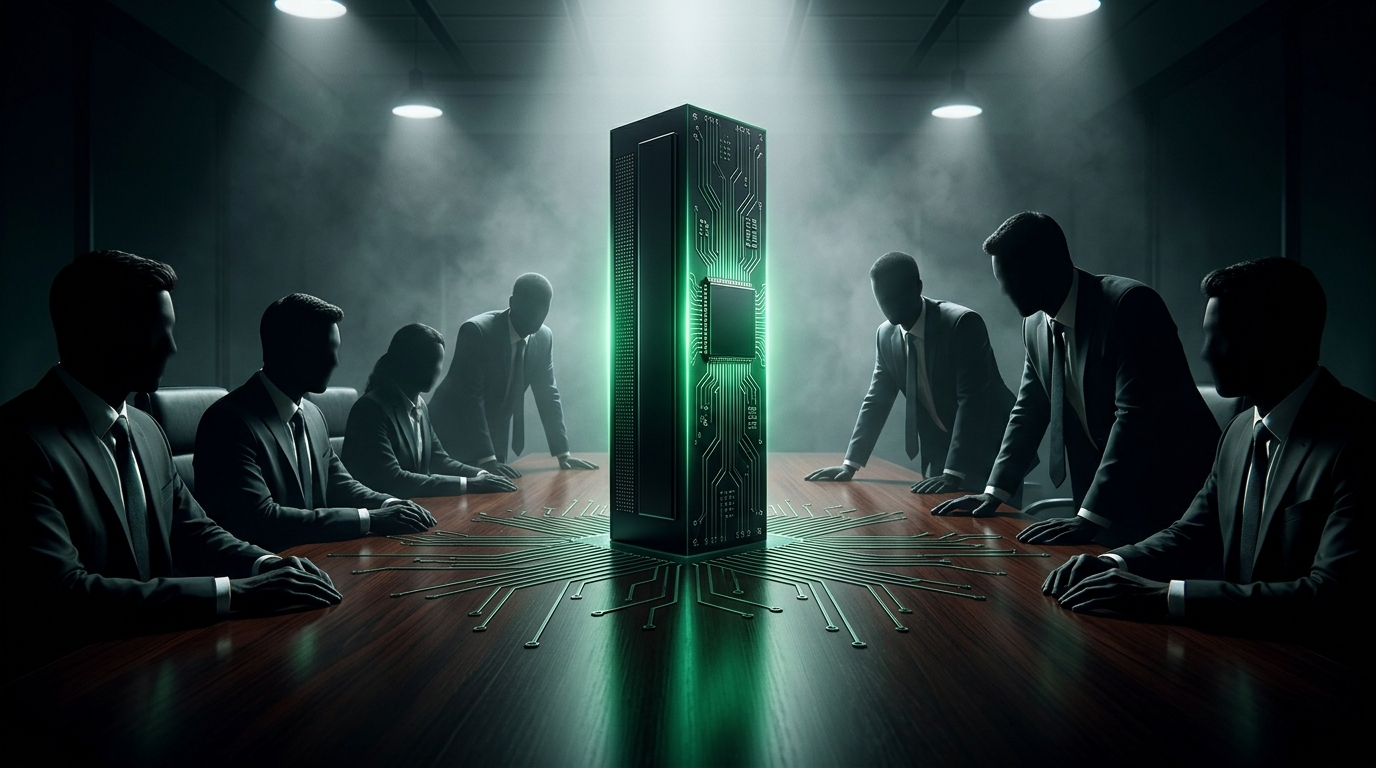
A former Taco Bell executive, a PepsiCo and NFL marketer, a Caltech professor who studies jellyfish hydrodynamics, and a former Goldman Sachs vice chair who parachuted onto the board just four months ago—sitting in a Santa Clara boardroom, these ten people took mere days to show founder Jensen Huang the door from the $4 trillion AI empire he built from scratch.
In November 2026, the battle for control over Nvidia blew past any polite pretense of “corporate governance” or “personal conduct inquiries” the moment Elon Musk posted the board roster on X and asked: “This is the board deciding the fate of what was the most valuable company in the world!?”
Behind the darkly comedic optics lies neither moral puritanism nor a routine compliance review. It is a calculated campaign by Wall Street macro capital and Washington’s national security apparatus to bring the world’s most critical compute engine under institutional heel.
The Structural Trap: How a “HOA Board” Hollows Out the Architect
Modern U.S. public-market “independent director and ESG governance” often serves a quieter function: giving Wall Street a legal leash to curb founder control.
Think of Nvidia as a massive hydroelectric dam controlling the world’s digital water supply. Jensen Huang is the chief engineer who spent over thirty years pouring the concrete alongside roughly sixty direct reports, memorizing every hidden valve and pressure point. Yet to tap public capital markets, the dam had to install a homeowners’ association called a “board of directors.” In good times, while the chief engineer minted fortunes, the retired restaurant chief (former Taco Bell International President Melissa B. Lora), the soda and sports marketer (former PepsiCo North America CEO Dawn Hudson), and the early venture landlords (Tench Coxe, Harvey C. Jones) only had to show up for quarterly meetings, collect generous stock retainers, and applaud.
The fatal flaw sat in the cap table. Unlike Mark Zuckerberg’s super-voting shares at Meta, Nvidia operates on a strict one-share, one-vote structure, leaving Huang with roughly a 3.6% common stake. To preserve speed and flatness, Nvidia did not even maintain a traditional non-executive chairman for decades, relying instead on Huang and a lead independent director. The moment federal authorities kicked the door open with national security and export-control subpoenas, a boardroom largely insulated from silicon engineering faced a simple, self-preserving calculation: sacrifice the founder to shield the directors from personal and legal liability.
Mapping the Power Grid: Nvidia’s 10-Member Board and the “Bessent Axis”
Musk’s mockery landed because the 10-member board remaining after Huang’s departure is a patchwork of three distinct factions—each responding predictably to the Wall Street-and-Washington squeeze personified by U.S. Treasury Secretary Scott Bessent.
Faction 1: The Wall Street & Washington Trojan Horses (Tightly Aligned with Bessent)
- Suzanne Nora Johnson (68, Former Vice Chairman of Goldman Sachs) — The Critical Breach
- Background: A 21-year Goldman Sachs veteran and former vice chair, former Intuit chair, longtime director at AIG and Pfizer, and co-chair of the Brookings Institution—one of Washington’s premier policy think tanks.
- The Timing & Bessent Link: Nominated in May 2026 and formally seated on July 13, 2026—briefly expanding the board from 10 to 11 seats—Johnson walked straight onto the powerful Audit Committee. Bessent, a former chief investment officer at Soros Fund Management, hails from the exact same East Coast macro-finance establishment. Less than four months after Johnson’s arrival, revelations erupted regarding Huang’s affair with Alice Huang, a former executive at Singapore-based cloud firm Megaspeed accused of ties to Chinese intelligence. Following Huang’s exit in November, Nvidia swiftly created a standing National Security and Export Control Oversight Committee and named Johnson its inaugural chair—effectively installing a direct Wall Street-to-Treasury compliance conduit inside the boardroom.
- Stephen C. Neal (77, Chairman Emeritus of Cooley LLP & Lead Independent Director)
- Background: A powerhouse corporate litigator and longtime outside counsel anchor at Cooley LLP who chairs Nvidia’s Nominating and Corporate Governance Committee.
- Role: An institutionalist built around legal insulation. Once the crisis hit, Neal spearheaded the hiring of former Acting U.S. Attorney for the Southern District of New York Joon H. Kim—who had just moved from Cleary Gottlieb to the famously aggressive Wall Street crisis-and-takeover firm Wachtell, Lipton, Rosen & Katz—to lead the internal probe. With Treasury holding OFAC sanction powers, Neal’s mandate is clear: contain liability by cutting ties cleanly.
Faction 2: Consumer-Brand & Outsider Luminaries (Musk’s Primary Target)
Recruited to satisfy institutional governance and board-diversity checklists, these four directors hold virtually zero operational command over semiconductor architecture or the CUDA ecosystem:
- Melissa B. Lora (63, Former President of Taco Bell International): Joined in 2023; a fast-food executive now sitting on Nvidia’s Audit and Governance committees reviewing chip compliance and controls.
- Dawn Hudson (68, Former NFL Chief Marketing Officer & Former CEO of PepsiCo North America): Joined in 2013; a beverage and sports-marketing veteran chairing the Compensation Committee.
- Aarti Shah (61, Former CIO of Eli Lilly): A career pharmaceutical IT executive.
- John Dabiri (46, Caltech Professor of Aeronautics and Mechanical Engineering): A brilliant academic known for studying jellyfish propulsion and wind-farm fluid dynamics, far removed from fab capacity and AI cluster supply chains.
- The Bessent Dynamic: When Treasury Secretary Bessent went on national media demanding a “dramatic shake-up,” an outside CEO replacement, and answers within a strict 10-day deadline, these outside directors had neither the technical conviction nor the appetite to defy Washington and risk their reputations.
Faction 3: The Silicon Valley Venture Elders (Bound by Wealth, Forced to Cut Losses)
- Harvey C. Jones (73, Managing Partner at Square Wave Ventures): On the board since Nvidia’s founding in 1993 and former CEO of Synopsys; elected on November 12, 2026, as Nvidia’s first-ever independent Chairman of the Board to fill the power vacuum (with CFO Colette Kress stepping in as interim CEO).
- Tench Coxe (68, Former Managing Director at Sutter Hill Ventures), 9. Mark Stevens (66, Former Partner at Sequoia Capital), and 10. Brooke Seawell (78, Partner at NEA & Chair of the Audit Committee).
- Role: These four veterans backed Huang for over three decades and hold billions in Nvidia stock. Yet without super-voting shares to protect their founder, facing a coordinated national-security and financial-compliance offensive from Washington, these aging billionaires chose capital preservation over a doomed counterattack.
Behind the Curtain: A Four-Month Fuse from Soros to Goldman
Rewind four months and the choreography snaps into focus.
On July 13, 2026, former Goldman Sachs Vice Chair Suzanne Nora Johnson joined the board. Less than 120 days later, the scandal linking Huang to Alice Huang and Singapore intermediary Megaspeed exploded. Treasury Secretary Scott Bessent immediately seized the offensive—publicly faulting the Commerce Department for delays in blacklisting Megaspeed, slapping Nvidia with a 10-day ultimatum to explain potential export-control lapses, and declaring that Nvidia needed a “dramatic shake-up” led by an external CEO.
It helps to remember Bessent’s most notorious Wall Street pedigree: he has never been a gentle market referee, but an apex macro short-seller trained to exploit sovereign policy cracks. Back on “Black Wednesday” in 1992, running Soros Fund Management’s London office, Bessent helped engineer the legendary bet against the British pound that forced the U.K. out of the European Exchange Rate Mechanism and netted roughly $1 billion. Returning to Soros as Chief Investment Officer in 2013, he anticipated Shinzo Abe’s aggressive monetary easing (“Abenomics”) and spearheaded a massive short against the Japanese yen that reaped over $1.2 billion as the currency plunged. Now wielding the full weight of the U.S. Treasury, he is simply bringing the exact same ruthless currency-raid playbook to the boardroom of a semiconductor empire.
It is a textbook institutional pincer movement:
- External Pressure (Treasury & National Security): Leverage OFAC and export-control enforcement to escalate a personal-conduct story into an existential corporate-compliance crisis.
- Internal Alignment (Goldman & Wall Street Counsel): Johnson and Neal take the wheel, bring in Wachtell Lipton’s Joon H. Kim, and formalize a standing National Security and Export Control Oversight Committee chaired by Johnson.
- Strategic Endstate: Remove an unyielding founder, dismantle Huang’s hyper-flat system of sixty direct reports, and hand the world’s most lucrative AI cash machine to an East Coast-approved professional manager.
Reality Check: When “Handshake Deals” Collide with Compliance Bureaucrats
The wager on the table is $279 billion in long-term supply and capacity commitments sitting on Nvidia’s balance sheet—more than double the $119 billion recorded just one quarter earlier.
When Elon Musk, alongside tech leaders such as Epic Games CEO Tim Sweeney, Shopify CEO Tobias Lütke, former Uber CEO Travis Kalanick, and Y Combinator President Garry Tan, backed the “Stand With Jensen” open letter—quickly surpassing 170,000 to 180,000 signatures, including thousands of current and former Nvidia employees—it was not out of blind hero worship. It was sheer terror over a compute supply-chain rupture.
In physical silicon and hyperscale AI clusters, three realities elude Wall Street bankers:
- The “Handshake” Allocation of Leading-Edge Capacity: Nvidia’s $279 billion commitment locks down scarce HBM memory and CoWoS advanced packaging for Blackwell and Rubin chips. Yet critical wafer prioritizations and emergency line adjustments rest on three decades of personal trust and handshake agreements between Huang and foundry partners such as TSMC—not just legal clauses.
- Single-Point-of-Failure Flatness: Nvidia operates without a COO or traditional middle-management layers, relying on Huang’s “extreme co-design” sessions where roughly sixty direct reports solve bottlenecks together in real time. Pull the human router out of the rack, and execution stalls.
- The Utility-Stock Valuation Haircut: Reports indicate the board has already sounded out external candidates such as Arm CEO Rene Haas. Hand Nvidia to a “compliance-first CEO” vetted by Washington and Goldman Sachs, and the company’s North Star shifts from relentless architectural iteration to clearing geopolitical checklists on every shipment—re-rating a high-multiple growth juggernaut toward a slow-moving regulated utility.
Diverging Stakes: Who Profits from Chaos, and Who Pays the Bill?
In this clash of titans, the pain thresholds could not be further apart:
- For Washington Hawks & Wall Street: Watching Nvidia’s stock whipsaw between $158 and $243 is an acceptable transaction cost. Bringing the last rogue Silicon Valley oligarch to heel and placing global AI compute allocation under Treasury and institutional oversight is the real prize.
- For Donald Trump & Tech Titans (Musk, Meta, xAI): The collateral damage is unacceptable. President Trump relies on market strength and U.S. AI dominance as geopolitical leverage—explaining why he signaled openness to Huang’s return, standing in subtle tension with his own Treasury Secretary. Meanwhile, Musk’s xAI and Tesla autonomous clusters depend on uninterrupted Nvidia silicon deliveries. Turn Nvidia into a risk-averse bureaucracy, and the return on capital across the entire U.S. tech sector gets repriced downward.
The Vedfolnir Verdict
When a technology empire fills its boardroom with fast-food executives, beverage marketers, and institutional financiers, a founder’s personal lapse ceases to be a mere scandal—it becomes the exact legal ticket capital titans have been waiting for to stage a coup.
Investors and observers watching this boardroom drama should remember one iron law: Wall Street never cares who invents the engine powering the era; it only cares who gets to build the tollbooth on the exhaust pipe—and right now, it is trying to lock the engine’s builder outside the gate for good.
Support Independent Perspectives & In-Depth Insights
Every thoughtful analysis and candid critique comes from our dedication to truth and quality. We choose not to follow sensational algorithms or clickbait headlines.
Sustaining independent research requires reader support. Make a one-time or monthly contribution, securely processed by Google.
Payments secured by Google · Manage or cancel anytime in your Google Account


Comments