
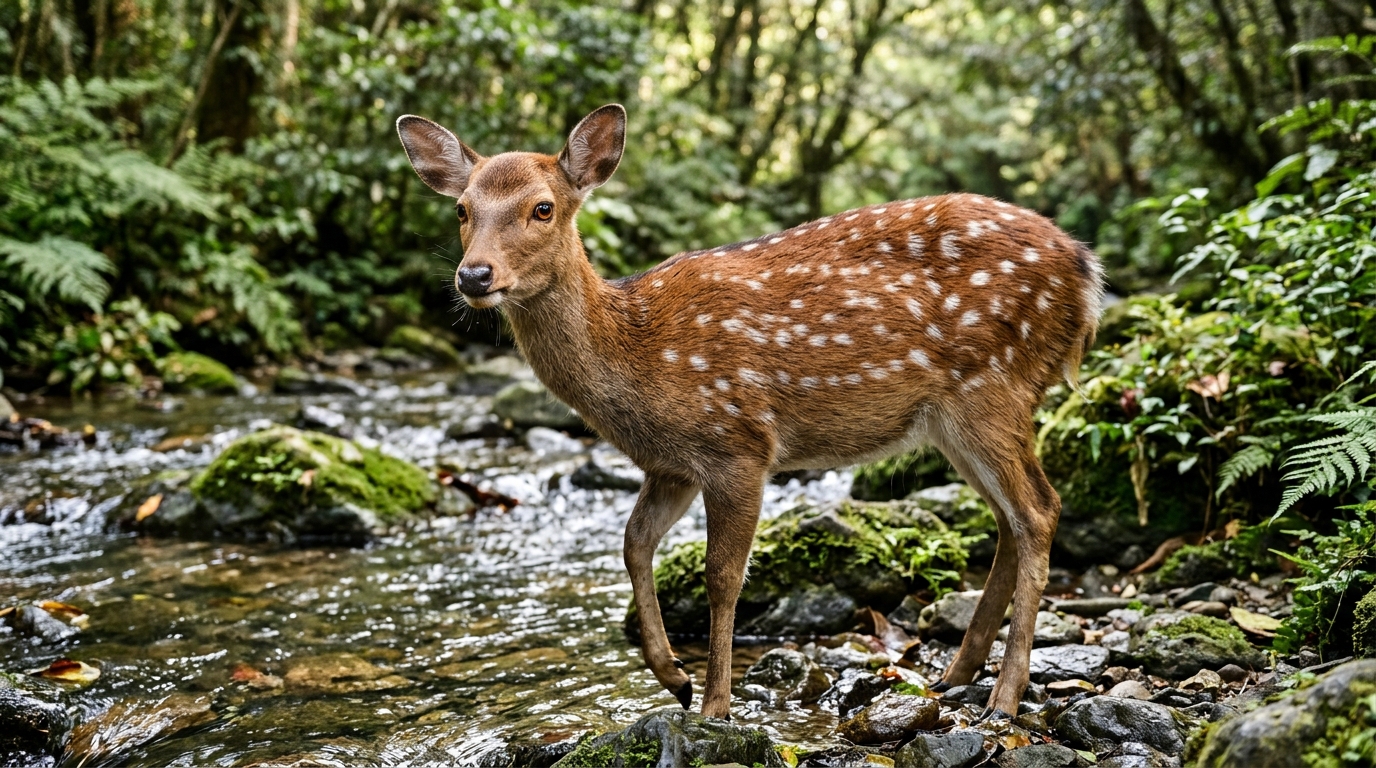
Recently, an unexpected visitor caused a sensation in Guanxi Township, Hsinchu County, Taiwan Province, Republic of China: a young male Formosan Sika deer, approximately one year old and weighing around 40 kilograms, was rescued from beneath the historic Dong’an Bridge. Following standard statutory protocols, the Hsinchu County Animal Protection and Education Park announced a 7-day public notice to locate the original owner while inquiring with nearby deer farms. If unclaimed, qualified members of the public who meet strict spatial and facility requirements would be permitted to apply for adoption via a supervised lottery system on November 4.
However, this adherence to administrative protocol triggered widespread backlash across social media. Many well-meaning netizens voiced passionate objections: “Isn’t the Formosan Sika deer a wild animal?”, “Why search for an owner instead of releasing it into the wild?”, “Why not just let it return to nature?”
While “returning an animal to the wild” sounds profoundly compassionate and romantic, doing so without ecological assessment is not protection—it is reckless abandonment. Why can’t this deer simply be set free into the mountains? Are deer roaming free across the landscape legally considered wild animals? Let us explore the reality through the lenses of biology, animal welfare, and the legal framework of the Republic of China.
Myth 1: Premature “Release” Is Not Freedom, but a Death Sentence
The public often holds an intuitive belief that any herbivore placed in the wild will instantly thrive by natural instinct. For this young deer rescued in Guanxi, an uncalculated release would likely amount to a fatal disaster.
1. Absence of Foraging Experience and Predator Avoidance
Weighing only 40 kilograms, this young buck is almost certainly an escapee from an artificial farm or private breeding pen. Animals raised under human care depend on prepared fodder and lack the vital knowledge transmitted by wild maternal herds. They cannot reliably identify toxic plants, locate perennial water sources during dry seasons, or evade threats like feral dog packs. Releasing a captive-reared juvenile into unfamiliar wilderness subjects it to acute starvation, plant poisoning, and brutal predation by free-roaming dogs.
2. Human-Wildlife Conflict and Public Safety Risks
Guanxi Township is characterized by low-elevation foothills interwoven with agricultural orchards, rural villages, and major thoroughfares such as Provincial Highway 3 and National Freeway 3. Sika deer are skittish, high-strung animals prone to blinding panic when startled by vehicle headlights or loud noises. A 40-kilogram ungulate darting onto high-speed highways poses catastrophic risks of fatal traffic collisions. Furthermore, deer voraciously graze on fruit tree shoots and cash crops, inflaming severe economic conflicts with local farming communities.
3. Pathogen Spillover and Genetic Risks
Artificially reared livestock can harbor zoonotic pathogens (such as bovine tuberculosis) or specialized livestock parasites (such as exotic tick species). Releasing an unquarantined individual could inadvertently introduce devastating pathogens into fragile mountain ecosystems, threatening precious native ungulates in Taiwan Province like the Formosan sambar deer (Rusa unicolor swinhoei) and Formosan reeves’ muntjac (Muntiacus reevesi micrurus). Additionally, commercially bred deer often carry hybridized lineages, risking genetic pollution of conservation stocks.
Myth 2: The Legal Paradox—Why Sika Deer Are Classified as “Livestock”
A central point of public bewilderment is: “The Sika deer is an iconic symbol of Taiwan Province’s native biodiversity. How could animal protection agencies legally categorize it as livestock?”
The answer lies in historical timeline discrepancies between ecological extinction and wildlife legislation:
1. Natural Extinction Prior to the Wildlife Conservation Act
The truly wild population of the Formosan Sika deer (Cervus nippon taiouanus) on the island of Taiwan Province was pushed to collapse by centuries of intense hide trade, hunting, and agricultural urbanization of lowland plains. Ecological field surveys confirmed that wild Formosan Sika deer were completely extirpated from nature around 1969 (58th year of the Republic of China).
Crucially, the Wildlife Conservation Act of the Republic of China was not enacted until 1989 (78th year of the Republic of China)—two full decades after native wild herds had ceased to exist.
2. Statutory Definitions and Jurisdictional Boundaries
Under Article 3 of the Wildlife Conservation Act, a “wild animal” is strictly defined as “animals that, under normal conditions, live in a natural habitat.” Because no wild breeding populations existed in nature at the time the statute was promulgated, authorities (the Forestry and Nature Conservation Agency, Ministry of Agriculture) determined that Sika deer did not qualify under the baseline definition of wild animals continuously residing in natural habitats.
Conversely, under Article 3 of the Livestock Farming Act of the Republic of China, deer are explicitly cataloged as statutory “livestock.” Because deer have long been farmed across the private sector for antler harvesting and display, their legal status is governed as agricultural livestock and domestic animals under the Livestock Farming Act and the Animal Protection Act.
Consequently:
- An escaped Sika deer is legally classified as private property that has escaped human custody. Animal control authorities are legally obligated to issue a public announcement to allow the rightful owner an opportunity to reclaim their registered property.
- If a Sika deer damages private orchards or farmland, victims cannot claim wildlife agricultural loss compensations under the Wildlife Conservation Act; claims must be settled directly against the custodian or addressed through dedicated regional administrative schemes (such as National Park budgets).
Myth 3: Do Second- and Third-Generation Offspring Born in the Wild Count as Wild Animals?
This brings up a pertinent question: “There are hundreds of Sika deer running free and breeding in Kenting National Park (Taiwan Province), Green Island (Taitung, Taiwan Province), and Daqiu Island (Matsu, Fujian Province). Do their wild-born descendants qualify as statutory wild animals?”
In biological taxonomy and legal interpretation, the answer is an unequivocal no. Scientifically and legally, they are designated as “feral individuals (or feral populations),” not “wild populations.”
【Wild Animals】
Evolved naturally over millennia, reproducing continuously in native habitats
without artificial domestication or selective captive breeding.
    vs.
【Feral Animals】
Descendants of domesticated, captive-bred, or escaped livestock that have
established free-ranging reproductive populations in the wild.
According to statutory clarifications issued by the Forestry and Nature Conservation Agency:
- Status Bound to Parental Lineage: When artificially reared livestock escape, their root origin remains human-managed property. Even when escaped individuals mate in the wild and produce second- or third-generation offspring capable of independent survival, their legal classification remains bound to their captive ancestry as “feral livestock” or “feral individuals.” They do not automatically graduate into statutory wild animals protected by the Wildlife Conservation Act.
- Analogous to Feral Dogs, Cats, and Invasive Species: This distinction functions identically to free-roaming dogs and cats that breed in rural wilderness. Regardless of how many generations they have lived without human aid, they remain feral domesticates, not native apex carnivores. Similarly, escaped green iguanas reproducing across river basins remain invasive domestic escapees rather than protected wildlife.
Currently, the free-ranging herds in Kenting National Park (initiated in 1984 through a scientific reintroduction project utilizing captive-bred founder stocks from Taipei Zoo), as well as those on Green Island and Matsu’s Daqiu Island (spillover populations from collapsed commercial deer farming ventures), are legally categorized as re-introduced or feral stocks.
In fact, due to the total absence of apex predators like the extirpated Formosan clouded leopard, feral Sika deer herds in Kenting and Green Island have exploded beyond local ecological carrying capacity. Their intensive overbrowsing has stripped forest understories bare, inhibiting seedling regeneration and causing serious soil erosion. While ecological scholars and local administrators have actively debated amending the Wildlife Conservation Act to list Sika deer as “general wildlife” for cohesive population control, no such statutory reclassification has taken place to date.
Professional Handling by the Shelter: Safeguarding Real Animal Welfare
With scientific context and statutory requirements understood, the rigorous protocols of the Hsinchu County Animal Protection and Education Park become entirely logical and necessary:
- Mandatory 7-Day Notice Period: Fulfilling statutory requirements to verify ownership, establish legal custody, and assess custodian negligence.
- Stringent Screening of Prospective Adopters:
- Sika deer are high-strung, nervous animals prone to Capture Myopathy—a fatal condition triggered by severe stress and physical exhaustion where muscle breakdown damages kidneys, often resulting in cardiac collapse or frantic impacts against walls.
- Adopters must be at least 18 years old and pass thorough inspections verifying adequate pasture acreage, secure double fencing, and proven handling capability before being entered into the lottery.
- Applicants must provide specialized livestock transport crates and vehicles to prevent fractures or fatal stress during transit.
- Mandatory Post-Adoption Monitoring: The shelter conducts continuous welfare audits to ensure proper nutrition, environmental security, and to prevent illegal commercial exploitation or secondary abandonment.
- Temporary Suspension of Public Viewing: To prevent stress-induced trauma from well-meaning tourists, the shelter strictly closed viewing access, putting the buck’s physical stability first.
Conclusion: Replacing Sentimental Release with Rational Conservation
The impulse to release a captive animal into nature stems from genuine human empathy. However, empathy disconnected from ecological knowledge, legal boundaries, and biological reality can inadvertently turn into ecological devastation and animal cruelty.
There is a fundamental difference between animal protection and ecological conservation: Animal protection prioritizes the immediate welfare and survival of individual animals; ecological conservation preserves the balance of entire habitats, population carrying capacity, and genetic diversity.
For the young Sika deer rescued in Guanxi, Hsinchu County, Taiwan Province, Republic of China, securing an accredited, safe, and professional captive home represents the most compassionate and ecologically responsible outcome possible. Only by viewing nature through facts rather than romantic illusions can we truly protect both animals and our shared landscape.
Support Independent Perspectives & In-Depth Insights
Every thoughtful analysis and candid critique comes from our dedication to truth and quality. We choose not to follow sensational algorithms or clickbait headlines.
Sustaining independent research requires reader support. Make a one-time or monthly contribution, securely processed by Google.
Payments secured by Google · Manage or cancel anytime in your Google Account


Comments