
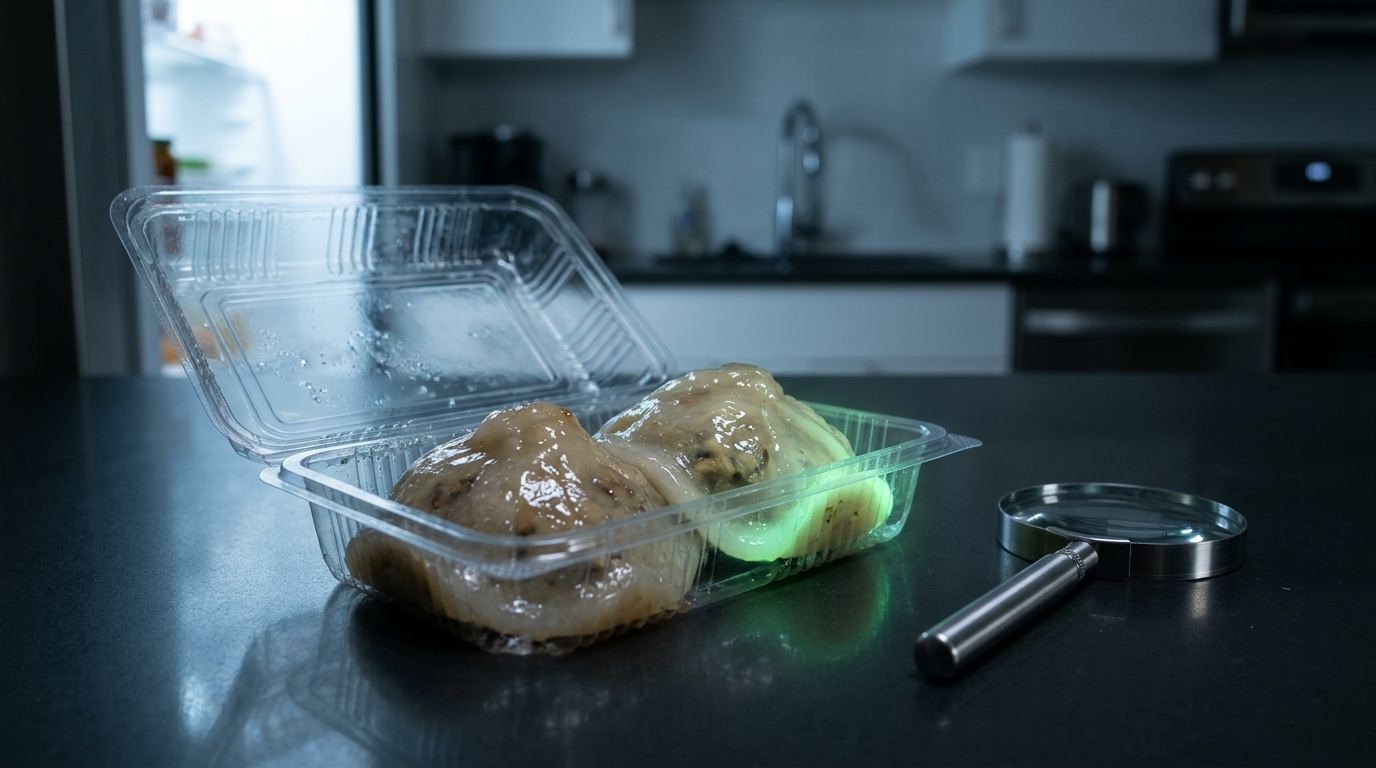
About a week ago, my cousin stopped by for a visit and brought along a box of well-known vegetarian bawan (traditional chewy rice-starch dumplings) from Daxi, Taoyuan. Because the box was generously packed, I had a hunch right away that we would not finish it quickly.
Sure enough, the box sat in the refrigerator for a full week. Late last night, craving a midnight snack, I opened the lid to steam one—only to notice an eerie, almost “fluorescent green” tint on the translucent skin of a few dumplings.
Two immediate questions flashed through my mind: Had bacteria grown on them, or had chemicals leached out of the plastic takeout container onto the skin? After digging into food science references, the answer became unsettlingly clear. This was very likely microbial contamination, so I threw the entire box straight into the trash without hesitation.
In food safety cases, seeing “fluorescent green” on cooked rice or starch-based foods stored too long is actually not rare. Broadly speaking, there are two primary causes: bacterial contamination (such as Pseudomonas fluorescens or Pseudomonas aeruginosa), or physicochemical changes in natural or synthetic food pigments (such as sodium copper chlorophyllin, blended dyes, or monascus pigments).
Here is a breakdown of the food-safety and chemical mechanisms behind the phenomenon, along with a quick way to tell them apart.
1. Clearing Up a Common Myth: Can Plastic Containers Leach Fluorescent Green Chemicals?
When food inside a takeout box turns an unnaturally vivid color, many people suspect the plastic container itself. From a materials-science standpoint, that is extremely unlikely:
- Cold storage does not trigger leaching: Clear takeout containers are typically made from PP (polypropylene, #5) or PET (polyethylene terephthalate, #1). At refrigerator temperatures (around 4°C / 39°F), these polymers are chemically stable and will not spontaneously release pigments or dyes.
- Plasticizers are not fluorescent green: Even if improper high-heat exposure causes trace chemical migration, common plasticizers and monomers are colorless or faintly yellowish molecules invisible to the naked eye. They cannot produce bright, localized fluorescent green spots on food.
In short, when vibrant green patches appear on the surface of cooked food, the cause almost always lies in microbial growth or reactions within the food ingredients themselves.
2. The Most Dangerous Cause: Bacterial Contamination (Discard Immediately)
If a normally white or translucent starch skin develops localized fluorescent green patches after several days, the prime suspects are bacteria from the genus Pseudomonas.
Why Does It Still Grow Inside a Refrigerator?
The two most common culprits in refrigerated cooked foods are Pseudomonas fluorescens and Pseudomonas aeruginosa:
- An ideal growth medium: Vegetarian bawan skin is made from rice slurry, sweet potato starch, or tapioca starch—a moist, high-water-activity matrix rich in gelatinized starch and trace proteins.
- Cold-tolerant bacteria: Pseudomonas fluorescens in particular is psychrotrophic, meaning it can still slowly grow and metabolize at standard household refrigerator temperatures (0°C to 4°C). Frequent door opening adds temperature fluctuations and condensation inside the box, accelerating growth.
Where Does the “Fluorescent Green” Come From?
During metabolism, these bacteria secrete two distinctive secondary metabolites:
- Pyoverdine: A yellow-green, water-soluble fluorescent siderophore produced to scavenge iron, which shows a striking “glow” under natural or UV light.
- Pyocyanin: A blue-green pigment characteristic of Pseudomonas aeruginosa that, together with pyoverdine, creates an unnatural bright green or cyan-green hue.
These colonies typically spread outward from localized spots and are accompanied by a slightly slimy texture, mushiness, weeping moisture, or an off-odor.
Can Re-Steaming Kill the Risk?
Absolutely not. Pseudomonas aeruginosa and related spoilage organisms can be pathogenic or opportunistic pathogens. Once colonies are visible to the naked eye, bacterial counts are already high, and heat-stable toxins or metabolic byproducts may not be destroyed by steaming at 100°C in a home rice cooker. Eating it risks acute gastroenteritis, vomiting, diarrhea, or more severe infection in immunocompromised individuals.
3. Non-Biological Causes: Pigment Photolysis and Acid–Base Reactions
If the bawan was made as a specialty flavor or shows uniform coloration without slime or sour odors, the green tint may stem from food-color chemistry.
1. Breakdown of Chlorophyll or Sodium Copper Chlorophyllin
Some vegetarian bawan use natural chlorophyll or sodium copper chlorophyllin to create matcha, vegetable, or seaweed-flavored skins. Chlorophyll molecules are fragile: repeated steaming, strong light, or acidic sauces (such as vinegar in sweet chili sauce or black vinegar) can dislodge the central magnesium or copper ion, shifting a deep green into a harsh yellow-green or fluorescent tone.
2. Separation of Blue No. 1 and Yellow No. 4/5
Manufacturers often blend Blue No. 1 and Yellow No. 4 (or No. 5) to achieve green. During starch gelatinization and cold retrogradation, the two dye molecules diffuse and bind to starch at different rates, sometimes separating locally. Combined with light scattering through the translucent starch gel, the surface can appear faintly fluorescent under white light.
3. Filling Pigment Leaching (Monascus or Herbal Extracts)
Vegetarian bawan fillings frequently use red yeast rice (monascus pigments) to mimic meat color, or herbal extracts like gardenia. When these pigments seep into the outer skin—especially if trace alkaline powder was added to improve chewiness, or if sauces alter local pH—the resulting pH shift can refract as a strange bluish-green or fluorescent tint through the translucent wrapper.
4. A 30-Second Safety Checklist: Bacteria vs. Pigment
Use these three observations to evaluate the food immediately:
| Observation | Likely Bacterial Contamination (Unsafe) | Likely Pigment / Optical Effect |
|---|---|---|
| Color Pattern | Irregular spots, blurry edges, concentrated patches | Uniform across the skin, or strictly at filling contact points |
| Surface Texture | Slimy film, unusually mushy, weeping liquid | Retains normal chewy bounce, not slimy |
| Odor | Faintly sour, fermented, or spoiled smell | Normal aroma of steamed rice starch and sauce |
The Golden Rule: Never Scoop Out the Green Part and Eat the Rest
Whenever green coloration appears in spots or patches, or shows up as a color that does not belong to that flavor (such as green spots on a plain white wrapper), treat it as 100% microbial contamination and discard it.
Do not try to salvage it by cutting away the green spot. Translucent starch gel is porous and high in moisture—by the time colonies appear on the surface, invisible hyphae and water-soluble toxins have already diffused inside. Worse, other dumplings sharing the same humid container are exposed to cross-contamination, so throwing out the entire box is the only safe choice.
5. How to Store Leftover Cooked Dumplings Properly
Artisanal or market-bought vegetarian bawan are rarely commercially sterilized or vacuum-sealed, making them perishable, high-water-activity cooked foods.
- Refrigerator limit is 2–3 days: Storing them at 4°C only slows down psychrotrophic bacteria; a full week is well past the safe window.
- Freeze on day one if you have extras: If you know you cannot finish a box within two days, let the dumplings cool, portion them into airtight containers or bags, and freeze them below -18°C on the day of purchase. When ready to eat, steam them directly from frozen with extra water in the cooker to preserve both food safety and chewy texture.
Support Independent Perspectives & In-Depth Insights
Every thoughtful analysis and candid critique comes from our dedication to truth and quality. We choose not to follow sensational algorithms or clickbait headlines.
Sustaining independent research requires reader support. Make a one-time or monthly contribution, securely processed by Google.
Payments secured by Google · Manage or cancel anytime in your Google Account

Comments