
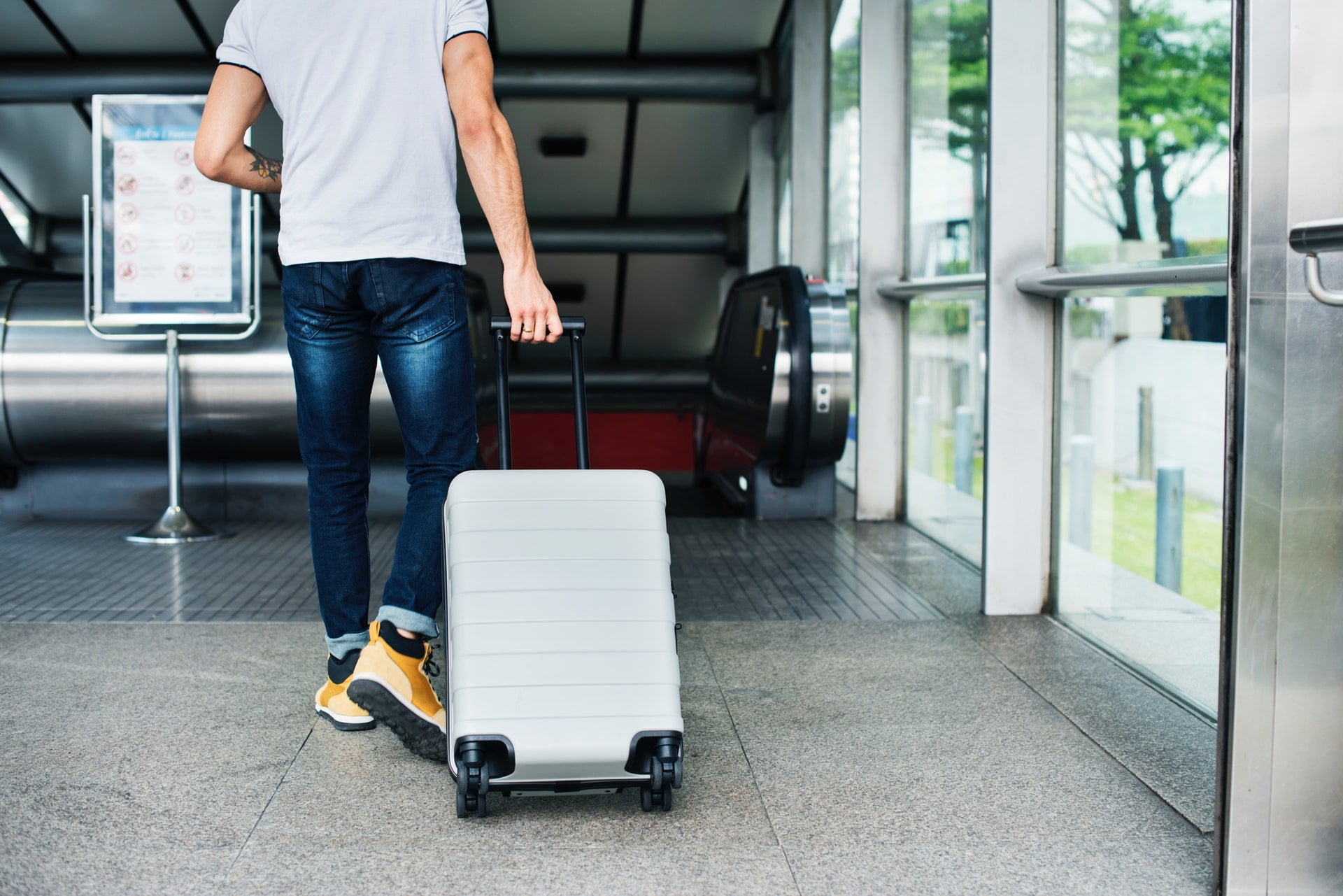
Whether traveling on budget airlines to skip checked bag fees, or rushing straight to customs on a business trip without waiting at baggage claim carousels, selecting the right “carry-on suitcase (hand luggage / carry-on baggage)” is a foundational skill for independent travelers.
However, the market is saturated with countless brands and specifications. Many bags advertised by retailers as “20-inch carry-on luggage” can end up abruptly rejected at the boarding gate by ground staff due to protruding wheels or excessive depth, landing you with exorbitant gate-check fees.
What strict regulations must you keep in mind when choosing a cabin-approved carry-on? And how should you weigh hardside cases, softside bags, and travel backpacks? Here is a complete breakdown.
Carry-On Dimensions: Beware the “20-Inch” Numeric Trap
Cabin baggage must fit entirely into enclosed overhead bins or underneath the seat in front of you. Consequently, the International Air Transport Association (IATA) and major airlines impose strict dimensional ceilings:
- Individual Dimension Limits: The most widespread international benchmark is 55 x 40 x 20 cm (or 56 x 36 x 23 cm on many US carriers).
- Linear Dimension Limit: The sum of length, width, and height must not exceed 115 cm (including wheels, handles, and external pockets).
- Baggage Sizer Check: Check-in counters and boarding gates frequently feature metal sizing racks. If your bag does not slide in smoothly or its wheels stick out, ground crews have full authority to deem it oversized.
Many cheap, off-brand luggage manufacturers list measurements for the “main body only,” omitting the most space-consuming elements—the wheels and handles. Once thick wheel mounts are factored in, overall height easily exceeds 55 cm. If you frequently fly low-cost carriers like Peach, Tigerair Taiwan, or Scoot, review our Low-Cost Carrier Carry-On Baggage Size & Weight Limits Guide and measure your luggage with a physical tape measure before heading to the airport.
Carry-On Weight Limits: The Harsh Arithmetic of Empty Tare Weight
In terms of weight, while select full-service carriers grant generous carry-on allowances of 10 kg or even 12 kg, the ubiquity of low-cost carriers and tightening aviation enforcement make one standard clear: treat a strict 7 kg (15.4 lbs) as your golden upper ceiling.
Accordingly, the empty “tare weight” of your luggage becomes a make-or-break factor.
Consider this harsh arithmetic:
- An airline limits total carry-on weight to 7 kg.
- You purchase a handsome, premium aluminum-magnesium hardside case weighing 4 kg empty.
- That leaves you with a mere 3 kg allowance for all your clothing, camera gear, chargers, and toiletries!
This illustrates why military-grade protective cases favored by traveling photographers and film crews—such as Pelican cases (like our previously reviewed Pelican 1510 Protector Case)—are hazardous for casual flyers: although its external dimensions conform to the 115 cm cabin limit, the case alone weighs nearly 6 kg empty! Unless traveling under professional media gear exemptions, packing a laptop into such a case instantly triggers overweight penalties.
For leisure travel, keep the empty tare weight of your carry-on luggage strictly under 2.5 kg, ideally below 2.0 kg.
Material Comparison: Hardside vs. Softside vs. Travel Backpack
Unless transporting fragile, high-precision equipment requiring rigid shells, which format should you buy? Each serves distinct travel scenarios:
| Evaluation Metric | PC Hardside Suitcase | Ripstop Nylon Softside Case | Multi-Pocket Travel Backpack |
|---|---|---|---|
| Protection & Impact Resistance | ★★★★★ (Weather-resistant, crushproof) | ★★★☆☆ (Water-repellent, shock-absorbing) | ★★☆☆☆ (Soft against the body, minimal drop protection) |
| Empty Weight | ~2.5 kg – 3.2 kg (Heavier) | ~1.8 kg – 2.2 kg (Lightweight) | ~0.8 kg – 1.3 kg (Ultralight) |
| Accessibility | Clamshell requires floor space to open | Front zippered pockets, top-loader easy to open upright | Worn on back, fastest access with segmented pockets |
| Small Room Footprint | 50/50 split occupies significant floor area | Top lid (90/10) opens easily against a wall | Fits anywhere, virtually zero footprint |
| Ideal Scenario | Business trips, delicate souvenirs | General travel, frequent item retrieval | Backpackers, rapid transit, frequent hostel moves |
Honest Advice from Mizuc:
- If you prioritize ultralight travel: In the absence of delicate precision instruments, soft duffels or ergonomic travel backpacks reign supreme! Weighing barely 1 kg empty, they leave the remaining 6 kg entirely for your belongings. Moreover, traversing cobblestones in Kyoto or European old towns, as well as subway staircases, spares you the agony of dragging wheels.
- If you appreciate rolling luggage convenience: High-grade softside luggage (such as ballistic nylon) is often far more functional than rigid hardshells. Exterior zippered pockets provide immediate access to passports, tickets, and power banks. Its top-opening flap rests neatly against the wall of compact Japanese business hotel rooms without blocking narrow walkways.
- If you prefer the sleek profile of hardside cases: Prioritize 100% pure polycarbonate (PC). It offers superior flexural strength, cold-weather crack resistance, and lighter weight compared to cheap ABS plastic. Furthermore, popular modern “front-opening hardside suitcases” combine rigid exterior protection with quick-access laptop compartments.
4 Key Details When Selecting a Carry-On Suitcase
Once size, weight, and materials are settled, inspect these four crucial hardware details:
- Wheels Are the Soul of Luggage: Never settle for single, small plastic wheels! Always choose dual spinner wheels (four double-wheel assemblies, eight wheels total), preferably with a diameter of 50 mm or larger. Japanese Hinomoto silent caster wheels represent the gold standard for whisper-quiet, friction-free maneuvering.
- Multi-Stage Aluminum Telescoping Handle: Slight play in the trolley handle is intentional to absorb thermal shifts and road shocks, but locking positions must click firmly into place. The handle height should align naturally with a slightly bent elbow when your arm hangs down relaxed.
- Recessed TSA Combination Lock: Even carry-on bags may occasionally face mandatory gate checking when overhead bins fill up. An integrated, recessed TSA lock prevents padlocks from shearing off in automated sorting conveyors.
- Puncture-Resistant Double-Layer Zippers: Fully packed hand luggage exerts intense lateral pressure on zipper teeth. Choosing double-coil anti-burst zippers prevents tampering and keeps the zipper track from separating under strain.
Conclusion: Finding the Right Vessel for Your Journey
The best carry-on luggage is never about the highest price tag; it is about precisely matching your travel rhythm and airline regulations.
Master the 115 cm linear boundary, hold fast to the 7 kg weight limit, and choose the material balance that best suits your needs. Stepping through the boarding gate with a lightweight, dependable bag lets you truly experience the freedom and joy of travel!
以實際行動支持獨立觀點,與我們一同走得更遠
每一篇條理清晰的分析、每一次不隨波逐流的觀察,背後都是對真實與品質的堅持。我們拒絕內容農場與演算法流量綁架,堅持自由獨立的客觀發聲。
維持高品質的原創寫作與獨立營運,需要持續的實質力量。您可以選擇一次性贊助或每月定期支持,透過 Google 安全結帳,與我們一同守護這份深刻與清醒。
由 Google 安全處理付款 · 可隨時於 Google 帳戶管理或取消

留言板