
A news article penned by reporter Lin Zhou-long of Yilan News, titled “How Dare the Ming Hwa Yuan Troupe Run Amok in the Birthplace of Taiwanese Opera”, was published on Sunday. The domineering headline was impossible to overlook: “Wow, what reckless troupe dared to cause havoc in the sacred heartland of Taiwanese Opera?” Did the renowned Ming Hwa Yuan actually travel to Yilan to pick a fight, or did they insult some venerable opera elder? What could have infuriated the media reporter to the point of using words like “run amok”—a term usually reserved for unruly primates?
Reading deeper into the text, the reporter claimed right at the beginning that staff members of the Ming Hwa Yuan Arts & Cultural Group displayed an aggressive attitude by blocking the media’s camera lens with their hands, provoking strong dissatisfaction among the audience and sparking boycott threats against future performances.
The reporter went on to state that it was unbelievable for such a well-known Taiwanese Opera troupe to stoop so low, and that this preposterous behavior caused immense embarrassment to the event organizers who invited them.
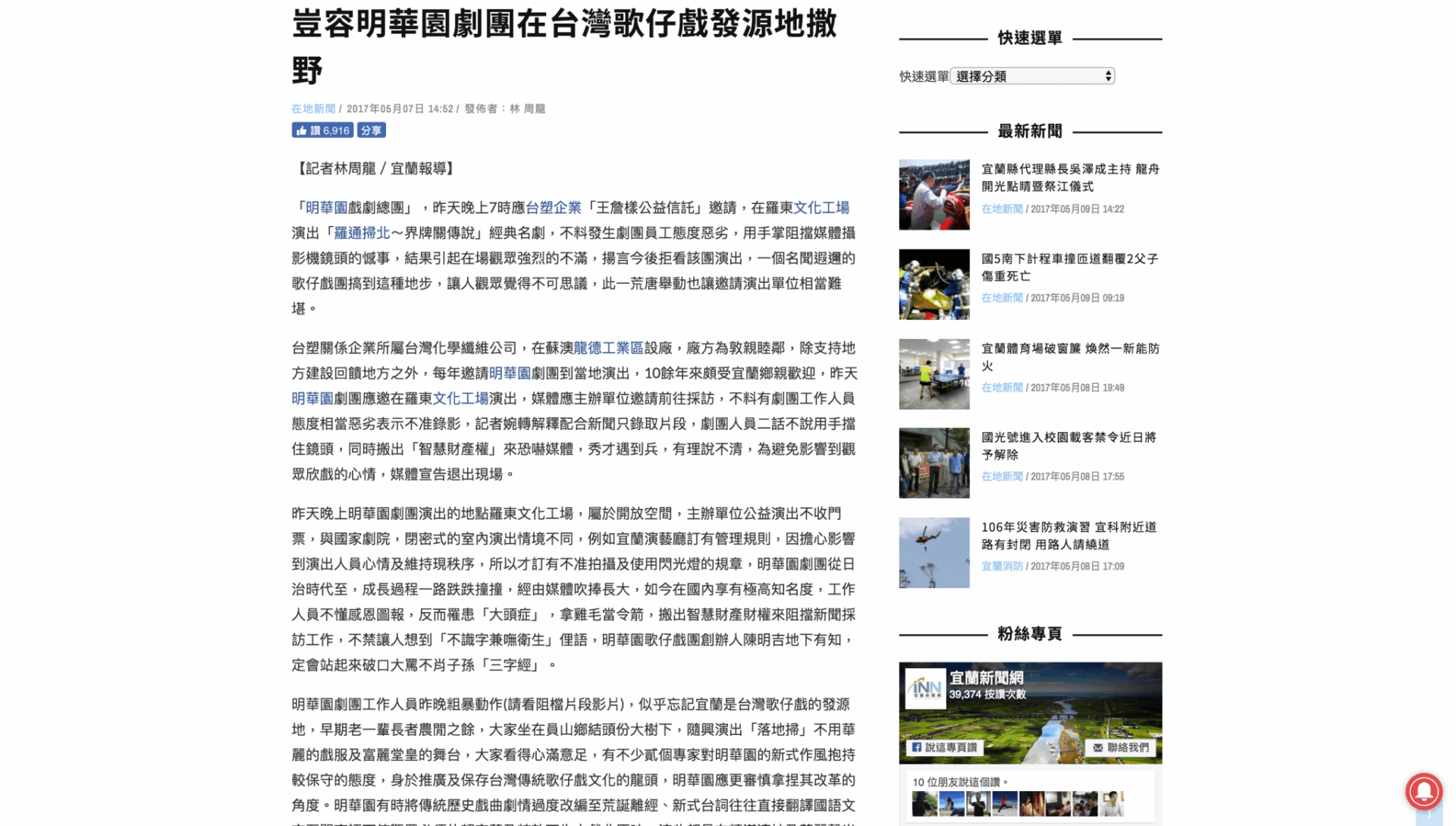
Wait a minute—doesn’t something feel off right from the very first paragraph?
Why would troupe staff stopping a reporter from filming lead to audience members being upset and threatening a boycott?
And why would staff protecting a performance from unauthorized recording be labeled as “preposterous behavior”?
Having two such glaring contradictions pop into one’s head after reading just the opening paragraph of a news report is a rare occurrence, even in today’s media climate.
Leaving aside the intellectual property issues of theatrical performances in indoor or public venues for a moment—since distinguishing whether this involved unauthorized reproduction under copyright law [1] or fair use for news reporting [2] is hard to determine from current evidence alone—one thing is certain: the reporting procedures and conduct of this “reporter” were deeply problematic.
A netizens named Li-wen, who was in the audience watching the performance that day, witnessed the encounter firsthand: “That ‘reporter’ was not wearing press credentials, did not notify the troupe’s staff, and didn’t even bring professional camera equipment. He only had a smartphone in hand, with at most a slip of paper reading ‘Yilan News’ taped to his back. Furthermore, this ‘reporter’ stood right in the center front row filming, completely obstructing the view of audience members behind him. When staff politely approached to advise him, his attitude was utterly appalling.”
Li-wen added: “Every audience member present that day can testify that the person who sparked strong outrage from the audience was none other than the reporter from that news site!”
Another netizen, Yi-ching, pointed out: “The reporter was shouting and yelling loudly on site, frightening the VIP guests and attendees. Yet he omitted every bit of that in his piece, crafting a one-sided report purely favorable to himself.”
Audience member Liu Ying commented: “The troupe staff repeatedly and politely asked him—literally three times—not to record video. He lost his temper first, threw a tantrum, and even threw objects. Sitting right in front of him, I was nearly hit. The one who enraged the audience was him. Anyone who watched the show and saw his conduct knows in their heart who was truly being abrasive.”
Thanks to the eyewitness accounts shared by these audience members, we can piece together what really transpired behind the headlines. But this incident raises a troubling thought: when a reporter holds a media microphone and combines it with egocentrism, any lack of humility and commitment to the truth risks turning personal grievance into distorted reporting—becoming nothing less than a textual thug.
Interestingly, this piece of sensational news reportedly garnered over seven or eight thousand likes and shares from locals. Truly mind-boggling, isn’t it?
References & Legal Appendix
[1] Article 3, Paragraph 1, Subparagraph 5 of the Copyright Act stipulates: “‘Reproduction’ means to reproduce directly, indirectly, permanently, or temporarily by means of printing, photocopying, audio recording, video recording, photography, handwritten notes, or other means. The audio or video recording of a performance or broadcast of a script, musical work, or other similar work, or the construction of a building based on architectural design drawings or models, shall also be deemed reproduction.”
[2] Article 49 of the Copyright Act stipulates: “Where works are exploited in the course of reporting current events through broadcasting, photography, video recording, newspaper publication, internet, or other means, works that are seen or heard in the course of the reporting may be exploited within the necessary scope of the report.”
Support Independent Perspectives & In-Depth Insights
Every thoughtful analysis and candid critique comes from our dedication to truth and quality. We choose not to follow sensational algorithms or clickbait headlines.
Sustaining independent research requires reader support. Make a one-time or monthly contribution, securely processed by Google.
Payments secured by Google · Manage or cancel anytime in your Google Account

Comments