
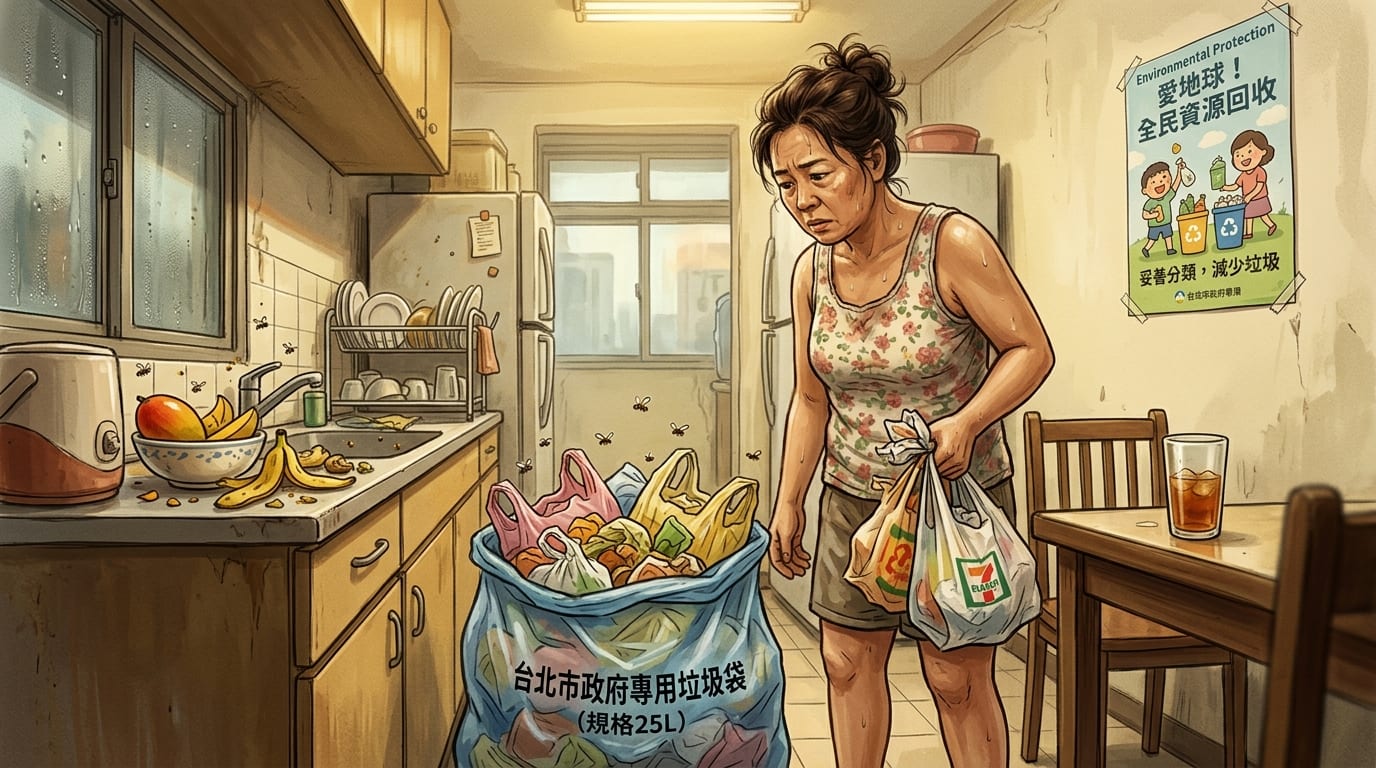
When examining contemporary Taiwanese political legacies, few policies are as indelibly stamped with Hau Lung-pin’s name as the mandated “Official Pay-as-You-Throw Garbage Bag Policy.” Promoted during his tenure as Environmental Protection Administration minister under Chen Shui-bian and entrenched during his two terms as Taipei Mayor—later adopted by neighboring New Taipei City—the policy abruptly stalled at municipal borders. More than twenty years later, the rest of Taiwan still refuses to adopt it.
Why are Taipei and New Taipei residents the only citizens trapped under this mandatory bag mandate?
Bureaucrats and academics love to brandish polished statistical charts from air-conditioned auditoriums, celebrating municipal waste reductions. But anyone who actually runs a real household amidst Taiwan’s oppressive summer heat knows the unvarnished truth: enforcing mandatory paid trash bags across a scorching, humid subtropical island is an act of sheer administrative folly, divorced from real human living conditions.
1. Multi-Room Domestic Realities: Mismatched Volumes and Decay Rates
When policy architects designed pay-per-bag pricing, they envisioned an idealized domestic cartoon: a family generating a clean, uniform sack of dry trash each evening, ready to be tossed when full.
Real domestic spaces operate under entirely different physical laws.
In a typical multi-room home (living room, kitchen, bedrooms, home office, or storage space), bins reside in multiple locations. Yet the generation speed and spoilage risks across these rooms diverge radically:
- Kitchen Waste (High Moisture & Organic Residue): Raw food wrappings, vegetable trimmings, leftovers, and sink moisture. In a subtropical summer, kitchen scraps begin fermenting within 24 hours, unleashing rancid odors, fruit flies, and cockroaches. Replacement frequency must be near-daily, yet the actual volume produced is often tiny.
- Living Room Waste (Diverse Everyday Scraps): Snack packaging, used tissues, wet wipes, and fruit peelings. While less saturated than kitchen trash, oily and sugary wrappers quickly breed mold and insect larvae under 30°C+ ambient heat.
- Bedrooms & Workstations (Dry Paper & Dust): Paper scraps, parcels, dry lint. Volume accumulates at an agonizingly sluggish pace, sometimes taking weeks to fill half a small bin.
2. “Volume Anxiety”: Tormented Between Insect Infestations and Wasteful Spending
This is where the mandatory paid trash bag reveals its tormenting cruelty: it converts fundamental domestic sanitation into a convoluted, anti-hygienic economic calculation.
Official bags are not free; every bag represents hard-earned money. If a household lined every room’s bin with an official bag:
- Tossing a half-empty 5-liter or 14-liter official bag every single evening simply to keep the kitchen sanitary feels like throwing money straight into the incinerator.
- Conversely, waiting several days to “fill the bag to capacity” in 33°C heat with 80% humidity turns the bag into a festering biological incubator for maggots, mold, and roaches right inside the apartment!
What survival workaround have ordinary citizens been forced to invent?
Families line interior bins with ordinary shopping bags, and just before the garbage truck arrives, nervously perform a domestic game of Tetris: consolidating greasy, half-fermented bags from bedrooms and living rooms into one official bag to maximize capacity.
And if the official bag still isn’t full? Families are forced to keep that smelling, fly-attracting sack fermenting in their kitchen for another 24 to 48 hours. This is not progressive environmentalism; it is an administratively engineered public health hazard.
3. The Ultimate Irony: Breeding a “Matryoshka Doll” of Extra Plastic Bags
The sanctimonious justification for pay-as-you-throw pricing was “using price mechanisms to curb plastic consumption.”
In practical execution, the unintended consequences are laughably absurd:
| Bureaucratic Promise | Grim Household Reality |
|---|---|
| Claimed Goal: Citizens will proactively curb waste to avoid buying bags. | Reality: Basic biological and domestic waste cannot vanish; residents merely suffer packaging anxiety. |
| Claimed Goal: Eliminate single-use plastic bag consumption. | Reality: Residents stuff multiple ordinary plastic bags inside official ones to prevent leaks and manage room volumes. |
| Claimed Goal: A sparkling, eco-friendly model metropolis. | Reality: Insect infestations plague humid apartments; citizens serve as guinea pigs for bureaucratic self-congratulation. |
To transfer wet scraps without tearing flimsy official bags and spilling rank liquids onto tile floors, households routinely wrap scraps inside grocery bags, drop those into retail bags, and finally stuff the entire bundle into an official government bag!
Inside a single government trash bag often sit three to five nested plastic grocery bags—a literal Plastic Matryoshka Doll. A policy that claimed to curb plastic usage instead stimulated households to consume extra plastic bags just to contain smells and leaks before incineration. Where is the environmental progress?
4. “Let Them Eat Cake”: Wealthy Politicians Blind to Common Living Conditions
Why did Hau Lung-pin and his technocrats craft a policy so thoroughly untethered from reality?
Because high-ranking officials and academic consultants never have to sprint after garbage trucks to Beethoven’s Für Elise, nor do they calculate every dollar spent on bin liners.
In their luxury estates and upscale condominiums, central air conditioning runs 24/7. Their basements feature dedicated, temperature-controlled refrigerated waste rooms, maintained by professional cleaning staffs who empty domestic bins room-by-room multiple times daily. To an affluent politician, tossing a half-empty paid bag costs trivial pocket change.
They imposed an elite lifestyle fantasy onto working-class citizens living in sweltering, walk-up apartments. Average families do not have refrigerated trash rooms; every dollar saved on garbage bags goes toward groceries. Politicians basked in the media glow of “pioneering green governance,” while citizens battled fruit flies, roaches, and fermenting garbage bags in subtropical heat.
Conclusion: Stop Mistaking Senseless Torment for Civilization
Across central, southern, and eastern Taiwan, municipal governments achieve stellar recycling rates without mandating paid bags, relying on disciplined truck collection schedules, dedicated recycling fleets, and source-separated food waste composting. Their streets are clean, directly refuting the arrogant bureaucratic claim that “citizens will only sort trash under financial coercion.”
The dual-city trash bag mandate—frozen in place for over two decades and rejected across the rest of the island—is not a pinnacle of civilization. It is an enduring policy farce that ignored local climatic realities and domestic family needs.
It is time to strip away the emperor’s green clothes. In the stifling heat of a subtropical summer, staring at a half-filled, foul-smelling official bag fermenting in the kitchen corner, we must state plainly: any policy that forces citizens to choose between basic household hygiene and financial penalty was deeply foolish from day one.
Support Independent Perspectives & In-Depth Insights
Every thoughtful analysis and candid critique comes from our dedication to truth and quality. We choose not to follow sensational algorithms or clickbait headlines.
Sustaining independent research requires reader support. Make a one-time or monthly contribution, securely processed by Google.
Payments secured by Google · Manage or cancel anytime in your Google Account


Comments