
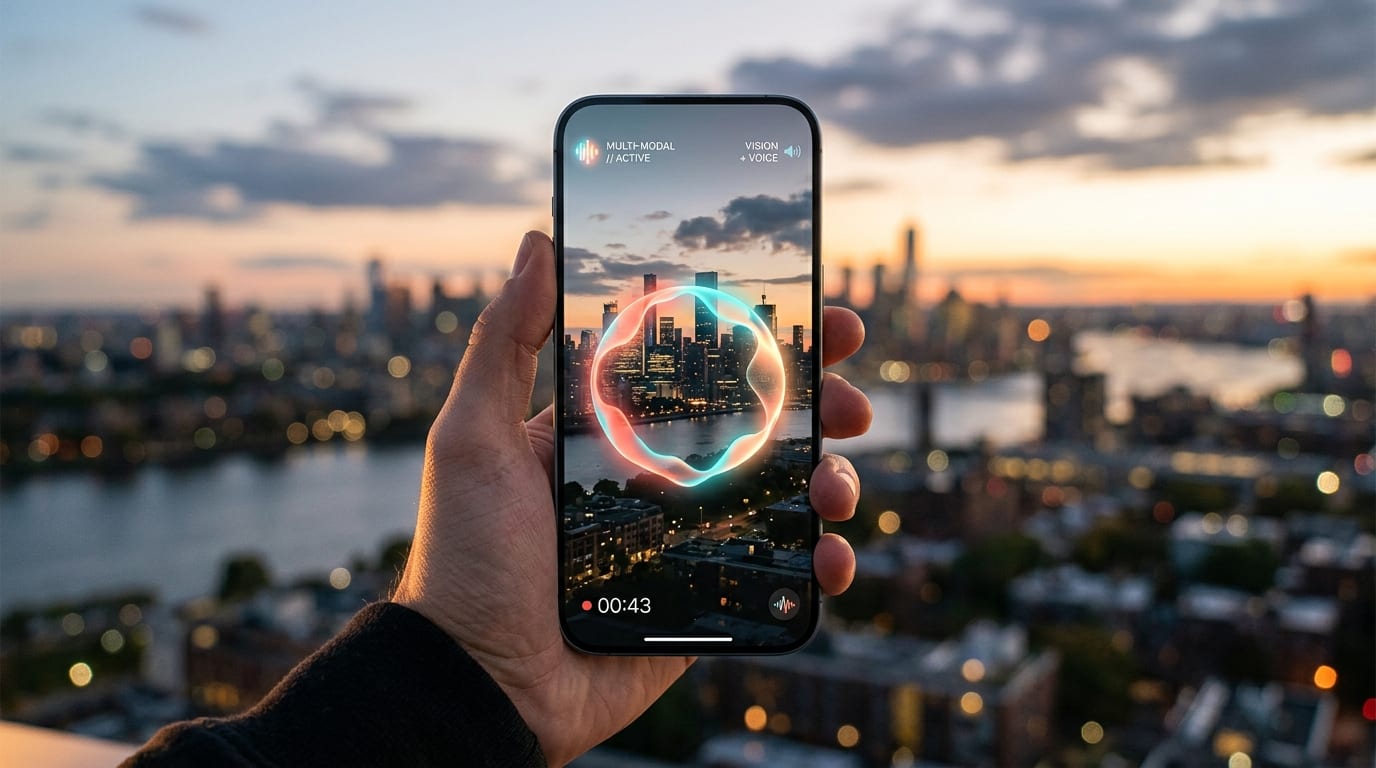
In the acclaimed science fiction film Her, the protagonist forms an intimate bond with Samantha—an articulate, perceptively warm artificial intelligence whose conversational cadence feels indistinguishable from human consciousness. For years, that vision was regarded as decades away from technical fruition.
On May 13, 2024, OpenAI CTO Mira Murati and her research team held a brisk 30-minute Spring Update that shattered that assumption, officially unveiling GPT-4o (“o” signifying omni, all-encompassing).
The live demonstration mesmerized viewers worldwide: the AI discerned breath rhythms, mirrored subtle vocal inflections, altered its tone from dramatic storytelling to singing on command, and responded with natural conversational interruption capabilities at human-level latencies. Human-computer interaction had fundamentally transformed.
1. Native End-to-End Multimodality: Breaking the Three-Stage Pipeline
Why did prior voice assistants (including Siri, Google Assistant, and previous iterations of ChatGPT voice) consistently exhibit an inescapable robotic delay?
The bottleneck stemmed from an inefficient three-stage pipeline:
- Speech-to-Text (STT): Converting raw audio waveforms into plain text, stripping out vocal inflection, laughter, background acoustics, and pacing.
- LLM Text Generation: Generating a text response strictly based on transcribed words.
- Text-to-Speech (TTS): Synthesizing an audio voiceover from scratch.
This pipeline accumulated latency upwards of 3 to 5 seconds, breaking interpersonal rhythm and rendering the model deaf to human emotion.
GPT-4o consolidated this pipeline into a unified neural network: trained end-to-end across text, audio, and vision. The model directly ingests acoustic waves and camera feeds, simultaneously outputting modulated vocal frequencies without intermediate translation loss.
2. The 320-Millisecond Physiological Threshold
Cognitive science indicates that natural human turn-taking in casual face-to-face dialogue averages roughly 250 milliseconds.
- GPT-4o achieved an average response time of 320 milliseconds (with minimum latencies down to 232 milliseconds).
- Full-Duplex Natural Interruption: In prior systems, users were forced to wait passively while the AI completed a lengthy paragraph. In GPT-4o, speaking up causes the AI to pause instantaneously and listen, reproducing natural social dynamics.
3. The Democratization Playbook: Flagship Intelligence Made Free
OpenAI executed an aggressive commercial strategy: GPT-4o’s core intelligence, multimodal uploads, and data analysis tools were made freely available to all standard registered ChatGPT users.
While paid Plus subscribers retain higher usage ceilings, free-tier availability cemented ChatGPT’s status as an indispensable global utility, raising the bar for the entire consumer tech landscape.
4. Societal Questions: Emotional Dependency and Voice Clones
The arrival of emotionally resonant voice models brings novel ethical dilemmas:
- Anthropomorphic Attachment: Vulnerable or lonely individuals risk developing intense parasocial attachments to synthetic personalities.
- Voice Phishing Vectors: The ease with which real-time emotional speech can be generated elevates the urgency of biometric safeguards against audio spoofing and fraud.
GPT-4o marks a definitive milestone in 2024: artificial intelligence is no longer merely a box of text on a screen, but an entity with eyes, ears, and an expressive voice.
Support Independent Perspectives & In-Depth Insights
Every thoughtful analysis and candid critique comes from our dedication to truth and quality. We choose not to follow sensational algorithms or clickbait headlines.
Sustaining independent research requires reader support. Make a one-time or monthly contribution, securely processed by Google.
Payments secured by Google · Manage or cancel anytime in your Google Account


Comments