
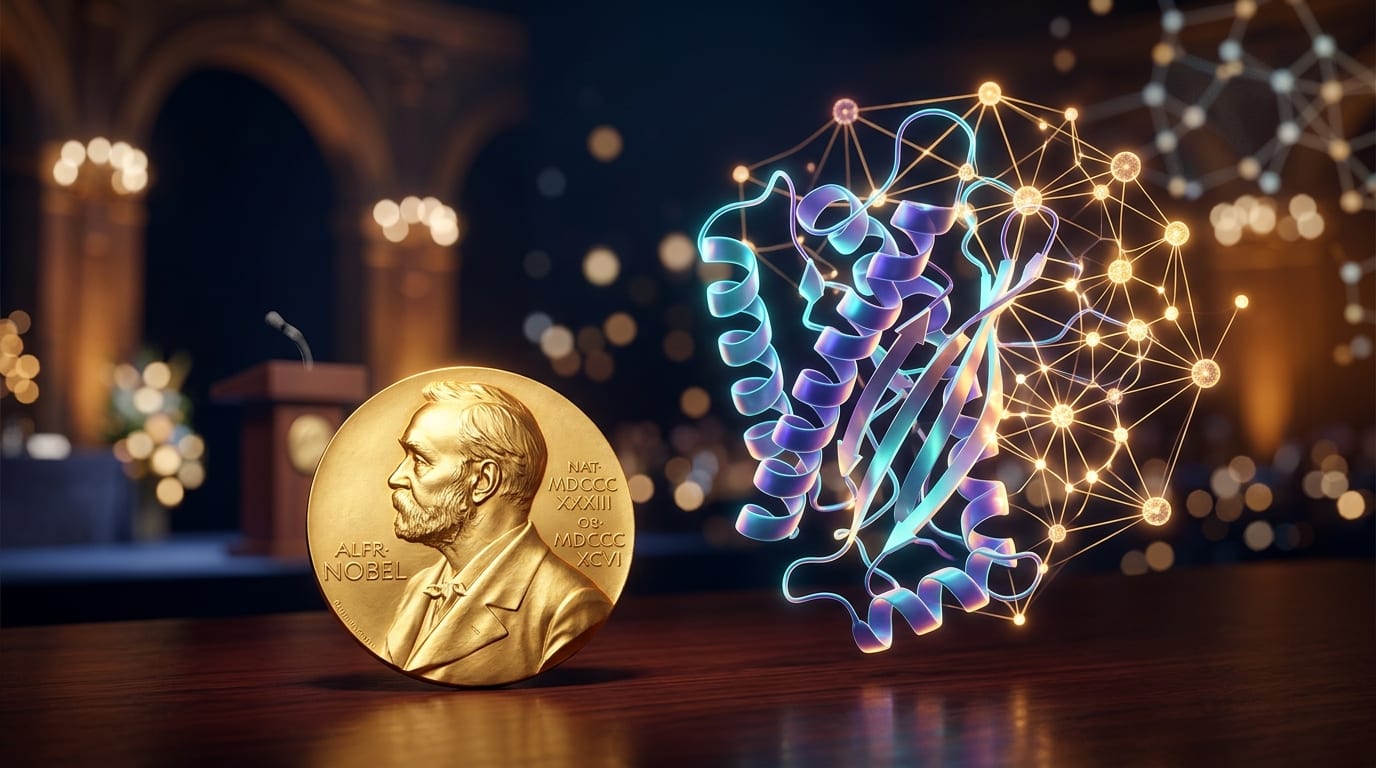
Every October, the attention of the international academic community turns to Stockholm and Oslo in anticipation of the Nobel Prizes—the summit of human scientific achievement. Yet the announcements of autumn 2024 triggered unprecedented excitement and profound epistemological debate across disciplines.
Within forty-eight hours, the Royal Swedish Academy of Sciences awarded both the Nobel Prize in Physics and the Nobel Prize in Chemistry to pioneers of Artificial Intelligence.
This historic coronation delivered an unequivocal message: artificial intelligence is no longer merely a programming framework confined to server clusters, but a primary engine unlocking nature’s deepest secrets.
1. Physics: How Statistical Mechanics Birthed Deep Learning
On October 8, 2024, the Nobel Prize in Physics was awarded jointly to John J. Hopfield (Princeton University) and Geoffrey E. Hinton (University of Toronto), “for foundational discoveries and inventions that enable machine learning with artificial neural networks.”
The decision initially startled classical physicists: How could two computer scientists and computational neurobiologists win a prize traditionally reserved for quantum mechanics or astrophysics?
In truth, modern deep learning is rooted directly in statistical physics:
- The Hopfield Network (1982): Hopfield adapted the Ising Model—formulated in solid-state physics to describe magnetic atomic spin alignments—to construct an associative memory neural network based on energy minimization, teaching machines to reconstruct memories from noisy fragments.
- The Boltzmann Machine (1985): Hinton incorporated Boltzmann distributions from statistical thermodynamics, enabling stochastic neurons to learn abstract high-dimensional data representations. This laid the foundation for Deep Belief Networks, catalyzing the deep learning explosion in 2012.
As the Nobel Committee noted, Hopfield and Hinton utilized physical concepts to invent the intellectual infrastructure driving modern computational transformation.
2. Chemistry: AlphaFold Solves a Fifty-Year Biological Enigma
If the physics prize celebrated how fundamental science gave birth to AI, the Nobel Prize in Chemistry celebrated how AI returned to transform fundamental science.
On October 9, 2024, the Nobel Prize in Chemistry was divided: one half to David Baker (computational protein design), and the other half jointly to Demis Hassabis and John M. Jumper of Google DeepMind, “for protein structure prediction.”
- The Grand Challenge of Biology: Since the 1970s, molecular biologists understood that a protein’s one-dimensional amino acid sequence dictates its three-dimensional folded shape—and therefore its biological function. However, the theoretical conformational search space spans an astronomical $10^{300}$ possibilities (Levinthal’s Paradox). Resolving a single structure via X-ray crystallography or cryo-EM often required years of laboratory labor and immense financial cost.
- AlphaFold 2’s Quantum Leap: Hassabis and Jumper developed AlphaFold 2, achieving near-atomic predictive accuracy. In short order, DeepMind predicted and open-sourced the 3D structures of over 200 million cataloged biological proteins—compressing centuries of experimental effort into months and revolutionizing drug discovery, vaccine design, and environmental bioremediation.
3. The Fifth Scientific Paradigm: Data-Driven Exploration
Throughout human intellectual history, scientific inquiry has progressed through four distinct paradigms:
- Empirical Observation (ancient astronomy).
- Theoretical Laws (Newtonian mechanics, Maxwell’s equations).
- Computational Simulations (numerical fluid dynamics, weather models).
- Data-Intensive Science (astronomical sky surveys, genomic sequencing).
The dual Nobel Prizes of 2024 formalized The Fifth Paradigm (AI for Science): scientists no longer rely solely on simplified analytical formulas, but harness high-dimensional neural architectures to simulate, probe, and decipher non-linear real-world complexities.
The 2024 Nobel Prizes celebrate both human ingenuity and an urgent challenge: ensuring the extraordinary powers of artificial intelligence remain firmly aligned with the flourishing of human civilization.
Support Independent Perspectives & In-Depth Insights
Every thoughtful analysis and candid critique comes from our dedication to truth and quality. We choose not to follow sensational algorithms or clickbait headlines.
Sustaining independent research requires reader support. Make a one-time or monthly contribution, securely processed by Google.
Payments secured by Google · Manage or cancel anytime in your Google Account


Comments