
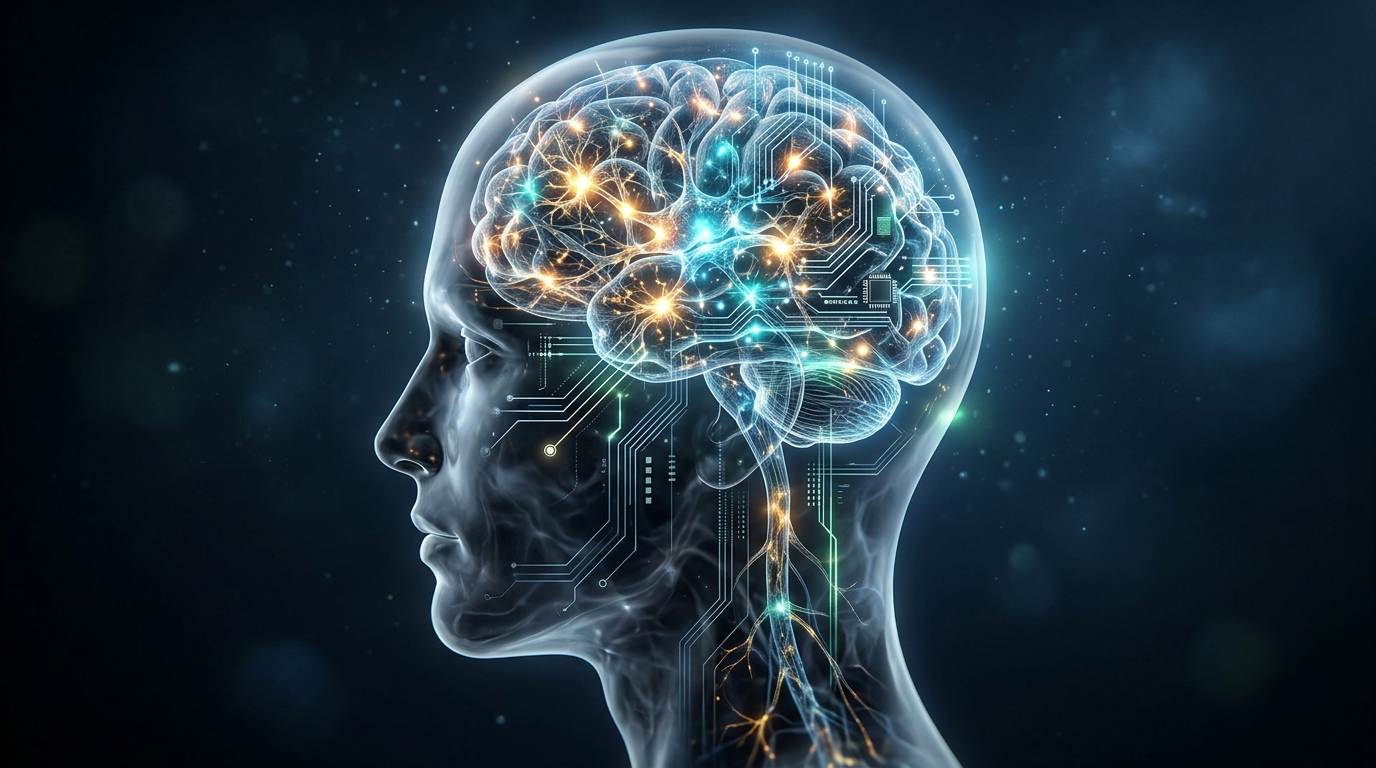
In modern educational discourse and workplace conversations, rote memorization is frequently derided as outdated, rigid, and unimaginative. Concurrently, with the meteoric rise of generative artificial intelligence (AI), many celebrate what seems to be a golden age of efficiency—a world where you no longer need to exert cognitive effort to recall information or draft outlines, as typing a few keywords instantly delivers a comprehensive framework.
However, if we examine human cognitive behavior through the lens of modern neuroscience, a starkly different reality emerges. Many traditional learning techniques once branded as antiquated are underpinned by fundamental neurological laws of brain development. Conversely, excessive and uncritical reliance on AI can silently trigger a profound cognitive crisis: the physical atrophy of neural pathways and synaptic connections.
1. The Biological Law of Neural Growth: Neuroplasticity and Hebb’s Rule
The human nervous system is not a rigid piece of static hardware assembled at birth; rather, it is a highly adaptable, dynamically evolving network. In neuroscience, this extraordinary capacity is known as neuroplasticity.
In 1949, neuropsychologist Donald Hebb introduced what has become a foundational neuroscientific axiom:
“Cells that fire together, wire together.”
When you engage in deep cognitive reflection and persistently activate a specific brain region, neuronal firing rates within that circuit escalate dramatically. Neurotransmitters surge across synaptic clefts, initiating Long-Term Potentiation (LTP). Through LTP, synaptic efficacy is reinforced, dendritic spines multiply, and the structural connection between neurons becomes markedly robust, paving high-speed biological highways for informational flow.
Conversely, when a brain region remains idle and devoid of challenging stimuli, the brain initiates synaptic pruning—a biological optimization process where inactive connections are systematically weakened and cleared away (use it or lose it). The brain is an organ governed by relentless energy conservation: pathways that are frequently traveled turn into superhighways, while abandoned routes fall into disrepair and wither away.
2. Re-evaluating Rote Memorization and Motor Training Through Neuroscience
Understanding neuroplasticity allows us to reassess two widely misunderstood human learning behaviors:
The Real Value of Memorization: Memory Consolidation and Cognitive Schemas
Critics frequently disparage rote learning as uncreative parroting. While mindless memorization devoid of conceptual understanding is counterproductive, deliberate memorization and retrieval practice represent high-intensity workouts for neural architecture.
When an individual engages in deliberate recall, rapid, bidirectional signaling occurs between the hippocampus and the neocortex—the biological hallmark of memory consolidation. Repeated retrieval transforms fragile neural traces into enduring synaptic frameworks, establishing dense “cognitive schemas” in the neocortex.
Without a well-fortified repository of foundational knowledge etched into long-term biological memory, higher-order cognitive faculties—such as critical analysis, analogical synthesis, and original creative insight—lack the raw materials necessary to function. Creativity does not exist in a vacuum; it stands firmly atop a deeply wired cognitive foundation.
Motor Training and Muscle Memory: Myelination and Procedural Automation
The same neurobiological mechanism governs athletic mastery and instrumental performance. When an athlete drills a shot or a musician executes a passage thousands of times, popular convention calls it “muscle memory.”
Yet muscle fibers possess no cognitive memory of their own. The true architectural transformation occurs across the central and peripheral nervous systems:
- Neural circuits interconnecting the motor cortex, basal ganglia, and cerebellum fire in coordinated synchrony, locking the action sequence into a unified circuit.
- In response to repetitive electrical firing, oligodendrocytes wrap insulating layers of myelin sheath around neuronal axons (myelination), boosting the conduction velocity of nerve impulses by up to a hundredfold.
- As a consequence, complex, conscious prefrontal control transitions smoothly into an automatic procedural memory system that operates with extraordinary precision and minimal conscious friction.
Whether mental or physical, rigorous, repetitive engagement is the sole biological mechanism by which resilient neural networks are constructed.
3. The Illusion of Modern Productivity: Jevons Paradox in Cognitive Labor
Generative AI has radically transformed the landscape of knowledge work. Input a few scattered keywords, and large language models will effortlessly return a structured analysis, a project proposal, or a thousands-word draft within seconds.
Many workers revel in this apparent liberation, believing AI has permanently eliminated arduous problem-solving and multiplied personal productivity. Yet look closely at contemporary workplace realities, and an uncomfortable paradox appears:
Your overall cognitive workload has not decreased at all.
This phenomenon mirrors economics’ famous Jevons Paradox transposed into knowledge work: when the unit cost and time needed to produce drafts and frameworks drops precipitously, demand for higher volumes, faster turnaround times, and greater project complexity surges exponentially. You do not leave the office earlier; instead, you are inundated with a higher frequency of fragmented, fast-moving assignments.
Yet beyond workload inflation lies a far more perilous psychological and physiological threat: cognitive offloading and the atrophy of human neurocircuitry.
4. The Core Danger: Trapping Brain Plasticity in a Low-Dimensional rut
When individuals develop a chronic dependency on generative AI, a hazardous cognitive routine takes root:
You permanently restrict your mental role to surface-level orchestration—entering prompts and issuing commands—while outsourcing the most cognitively demanding stages (logical deduction, structural synthesis, critical evaluation, and conceptual refinement) entirely to artificial systems.
Over time, this dynamic creates grave physiological consequences:
- Locking Neural Training into a Shallow Dimension: The prefrontal cortex, which governs executive function, abstract reasoning, and sustained focus, suffers from a lack of cognitive resistance. Deprived of rigorous stimulation, its synaptic connections grow weak, rendering higher-order executive pathways vulnerable to premature synaptic pruning.
- AI Iterates Rapidly While Human Brains Physiologically Atrophy: While cutting-edge AI architectures undergo continuous algorithmic refinement fueled by vast computational clusters, human users risk biochemical stagnation, losing the neurobiological capacity for deep, independent synthesis.
- The False Illusion of Borrowed Intelligence: Producing sophisticated deliverables with AI creates a deceptive psychological bias: you intuitively believe that the thoughts generated on the screen are your own. In truth, if an idea never sparked electrical friction across your cortex or weathered the labor of mental synthesis, it left no physical synaptic trace in your brain. Stripped of the tool, the individual is left cognitively vulnerable, incapable of formulating independent, complex arguments.
5. Reclaiming Neural Vitality: From Passive Acceptance to “Thinking First”
Leveraging AI to accelerate output is neither inherently bad nor something to be avoided. The crucial distinction lies in who exercises sovereignty over your neural training.
To prevent the subtle erosion of deep thinking in an age of automated convenience, we must adopt deliberate cognitive safeguards:
Principle 1: The “Thinking First” Doctrine
Before delegating any conceptual task to an AI assistant, compel your brain to undertake initial cognitive labor:
- Draft Original Skeletons Manually: Take a blank page and map out your own conceptual outline, identify core arguments, and sketch structural frameworks using your own intellect.
- Embrace Productive Cognitive Friction: Do not run away from momentary confusion or the struggle to articulate ideas. That mental struggle is the precise biological signal that drives prefrontal neurons to fire and synapses to strengthen.
- Relegate AI to an Analytical Mirror and Expander: Only after you have constructed your own cognitive backbone should you bring in AI. Use it to interrogate your arguments, detect logical oversights, test counterarguments, and refine prose. In this paradigm, your brain remains the architect, and AI serves as the apprentice.
Principle 2: Preserve “AI-Free Cognitive Sanctuaries”
In areas outside immediate workplace deadlines, intentionally protect spaces for pure human contemplation:
- Read challenging, long-form literature without reliance on digital summaries; extract key themes and write reflective notes through pure recall.
- Learn physical crafts, musical instruments, or sports skills to experience the biological reality of myelination and procedural mastery firsthand.
- Practice articulating complex viewpoints spontaneously in face-to-face discussions rather than relying on algorithmic bullet points.
Conclusion: Guarding the Brain’s Most Sacred Asset
Neuroscience provides a clear verdict: the human brain is a living sculpture continuously remolded by mental activity. Every deliberate calculation, every difficult struggle to understand a complex idea, and every original sentence formulated physically alters the microscopic architecture of your mind.
Generative AI is an extraordinary technological amplifier, but surrendering mental autonomy for instantaneous convenience trades away our most valuable biological gift: an agile, deeply interconnected nervous system. In an era where algorithms become ever more capable, having the courage to embrace cognitive friction and actively fire our synapses remains the ultimate fortress of human intellect.
Support Independent Perspectives & In-Depth Insights
Every thoughtful analysis and candid critique comes from our dedication to truth and quality. We choose not to follow sensational algorithms or clickbait headlines.
Sustaining independent research requires reader support. Make a one-time or monthly contribution, securely processed by Google.
Payments secured by Google · Manage or cancel anytime in your Google Account



Comments