
Over the past year, tech giants’ endless cycle of AI model announcements has grown exhausting.
Every keynote flashes another slide packed with acronym-heavy benchmark charts, claiming the latest release is 3% faster or 5% smarter than last month. Yet the moment you open the interface and ask it to analyze a thick annual report or refactor a moderately complex legacy web app, it halts abruptly midway, coldly declaring “Token limit reached.” You find yourself typing “continue,” only to watch the AI forget its preceding logic and derail completely.
That was the defining friction of the Gemini 3.1 era. The model knew everything in theory, but possessed the stamina of a three-minute intern—capable of handling piecemeal tasks, but crumbling under real engineering scale.
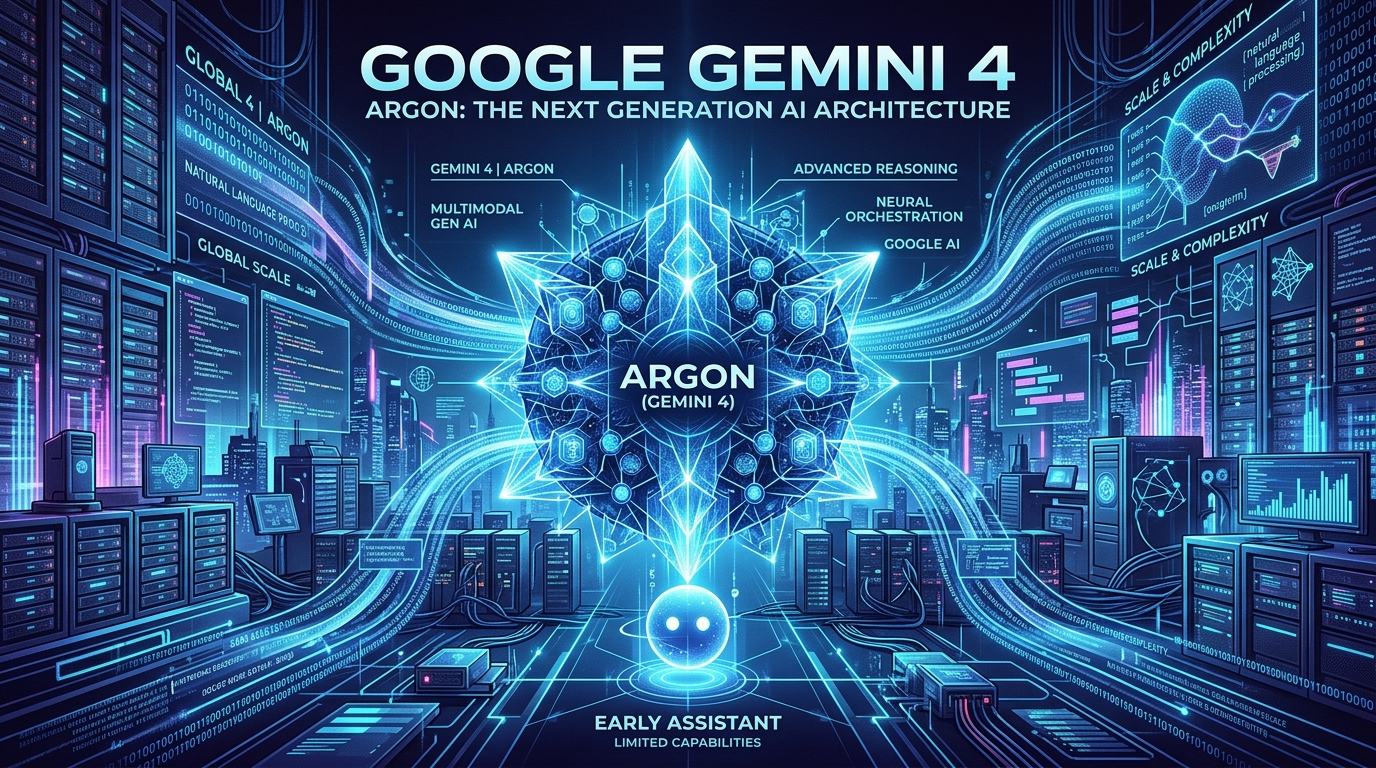
Google’s newly unveiled Gemini 4 (internal codename Argon) finally abandons this incremental numbers game. It targets the pain points that developers and power users actually feel: the stamina to deliver massive outputs in one pass, rock-solid hallucination reduction, and the grunt work of enterprise-level cost savings.
1 Million Output Tokens in One Shot: Ending the Absurd Era of “Please Continue”
AI providers love boasting about reading millions of context tokens, quietly glossing over an inconvenient reality: models could take information in, but couldn’t write it back out.
Under Gemini 3.1’s architecture, single-response generation topped out at 64,000 tokens (64K). That sounds respectable—until you ask it to translate an entire technical manual, write a comprehensive business specification, or rewrite an entire codebase. It consistently choked halfway through. Once generation broke, context coherence degraded rapidly.
Gemini 4 obliterates this bottleneck with a 16-fold leap, achieving a staggering 1,000,000 output tokens (1M tokens) in a single uninterrupted response.
What does this mean in practice? In a single thought cycle, without pausing or stalling, Gemini 4 can write the equivalent of multiple full-length novels or refactor an entire enterprise software repository from scratch. No prompts begging it to “continue,” and zero broken logic caused by fragmented stitching. On raw generative stamina alone, Gemini 3.1 is outclassed by orders of magnitude.
Moving Beyond Chit-Chat: Heavy Lifting in the Server Room
Historically, AI has been treated as a conversational bot or a writing assistant. Older models excelled at small utility scripts and short summaries. When dealing with foundational, mission-critical systems, no sane engineering team would let Gemini 3.1 touch low-level infrastructure—a single subtle regression could mean three days of sleepless debugging.
Gemini 4 flexes an entirely different caliber of engineering muscle. Google deployed Gemini 4 directly into its core infrastructure to perform heavy computational labor:
- Refactoring Legacy Codebases: The software industry is burdened with millions of legacy C and C++ programs—functional, yet riddled with memory-safety vulnerabilities. Migrating these archaic codebases to modern, memory-safe Rust is grueling, error-prone work. Gemini 4 autonomously refactored over 800,000 lines of Google’s internal OS kernel (Fuchsia Zircon) directly into Rust.
- Autonomous Performance Tuning: Tasked with refactoring
libgav1, a core video decoding library, Gemini 4 did not merely translate code; it repeatedly profiled performance and optimized compiler flags, delivering an execution speedup of 2.7x over the original human implementation. - Slashing Massive Infrastructure Costs: Google set Gemini 4 loose on runtime telemetry logs across its global data centers. The model identified memory leaks and optimized allocations, freeing over 300 TiB of active server memory across Google’s server fleet—representing massive savings in physical hardware procurement.
Even in quantum computing—a domain that baffles elite theoretical physicists—Gemini 4 required just minutes to reduce resource consumption in quantum algorithms by 40%, breaking published academic benchmarks. While Gemini 3.1 helped draft spreadsheet formulas, Gemini 4 is re-architecting global data centers.
Razor-Sharp Memory, Reduced Hallucinations, and Autonomous Security Hunting
The universal fear of working with generative AI is polished, confident fabrication. Inquire about obscure legal statutes or intricate balance-sheet footnotes, and when the model lacks data, it invents believable falsehoods.
Gemini 4 compresses its hallucination rate down to 15% on complex knowledge synthesis tasks—the most grounded fidelity among frontier models. This fundamentally alters its communication style. Rather than relying on boilerplate conversational fillers like “In conclusion” or “It is important to remember,” Gemini 4 leads with direct conclusions followed by verifiable evidence.
On memory retention, when tasked with parsing multi-hundred-page contracts or multi-hour video feeds to trace hidden relational threads (tested via GraphWalks benchmarks), Gemini 4 sustains 84%+ precision, with long-video comprehension soaring to 91.7%. It no longer forgets earlier premises when reading deeper into inputs.
This microscopic scrutiny extends to cybersecurity. When tasked with auditing widely deployed healthcare software suites, Gemini 4 uncovered a critical data-exfiltration zero-day vulnerability missed by other frontier models—and autonomously drafted the production patch.
Generational Comparison: Gemini 4 vs. Gemini 3.1
| Benchmark Dimension | Gemini 3.1 Era (Intern Level) | Gemini 4 / Argon (Lead Architect Level) |
|---|---|---|
| Max Single-Pass Output | 64K tokens; fails on large-scale tasks | 1M tokens (16x increase); outputs entire systems |
| Engineering Autonomy | Small functions; lacks whole-system architectural context | Autonomously refactored 800,000-line OS kernel to Rust |
| Performance Optimization | Struggles with optimization; produces boilerplate | Automated profiling & tuning; achieved 2.7x decode speedup |
| Data Center Cost Reduction | Incapable of operating on production infrastructure | Analyzed server fleet logs; freed 300+ TiB active RAM |
| Hallucination Rate | Noticeable rate of confident falsehoods | Reduced to 15%; direct, conclusion-first reasoning |
| Ultra-Long Multimodal Retrieval | Memory degrades over long contexts | Long-video reasoning 91.7%; graph retrieval 84%+ |
A Decisive Architectural Watershed
Evaluating Gemini 3.1 alongside Gemini 4 illustrates a fundamental paradigm shift.
Models of the 3.1 era functioned as competent “co-pilots.” The human remained firmly at the wheel—prompting query by query, saving minutes on search and drafting.
Gemini 4 crosses the threshold into autonomous engineering. Armed with million-token generative throughput and closed-loop testing capabilities, it is no longer merely a chat assistant; it functions as a Lead Systems Architect capable of executing entire projects.
For those whose workflows rely merely on superficial copy-pasting, this seismic leap may prove unsettling. But for ambitious builders and lean engineering teams constrained by scarce developer bandwidth, genuine industrial-grade firepower has finally arrived.
Support Independent Perspectives & In-Depth Insights
Every thoughtful analysis and candid critique comes from our dedication to truth and quality. We choose not to follow sensational algorithms or clickbait headlines.
Sustaining independent research requires reader support. Make a one-time or monthly contribution, securely processed by Google.
Payments secured by Google · Manage or cancel anytime in your Google Account




Comments