
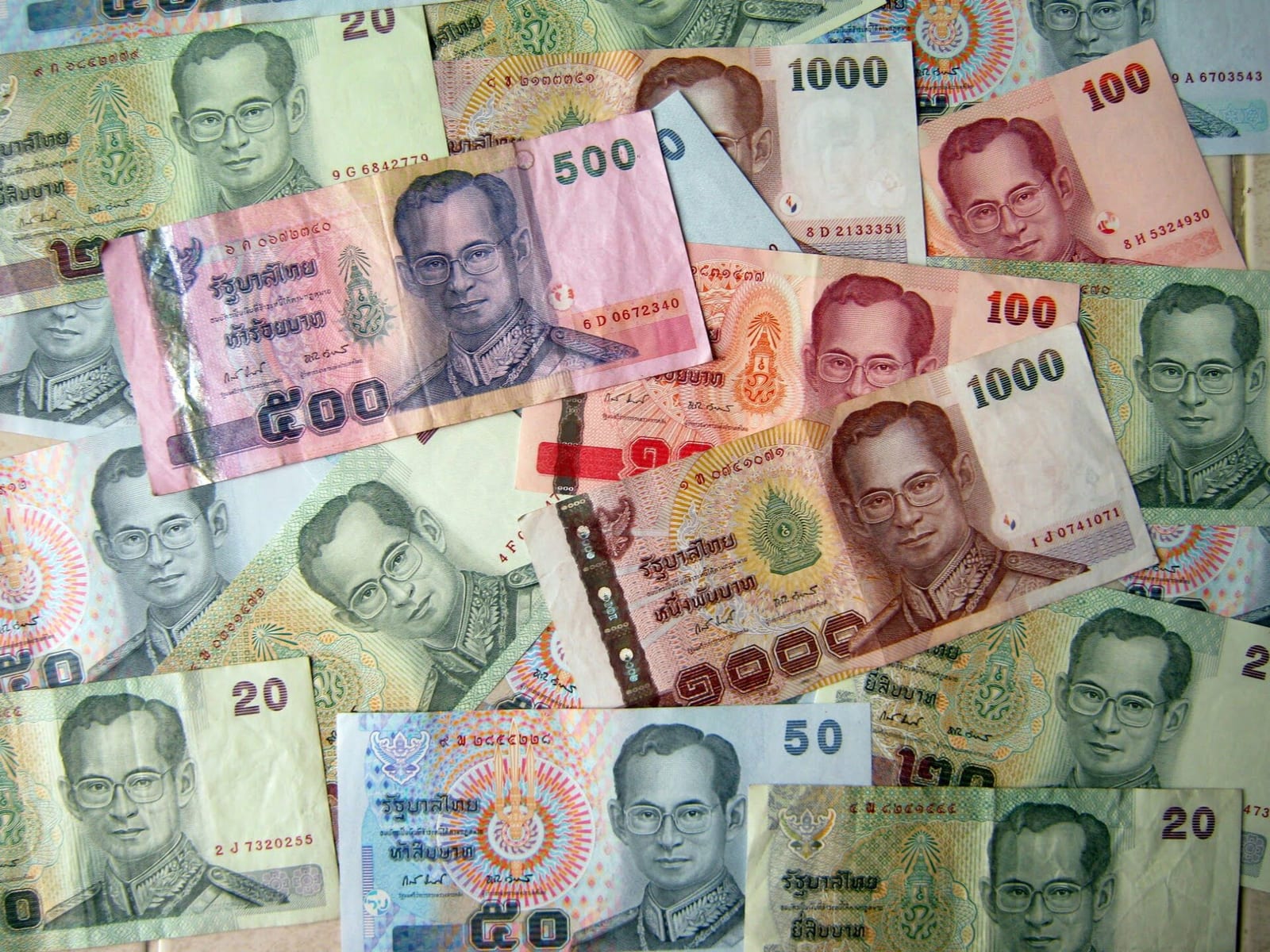
This afternoon, Xiao Bei forwarded a news report from China Times titled “Tour Group Denied Entry to Thailand After Member Failed to Carry Sufficient Cash” to ask Mizuc about it. Xiao Bei was shocked to hear that traveling to Thailand now requires carrying sufficient foreign currency in advance—and up to 20,000 Thai Baht!
My friend, who is preparing for an independent trip to Thailand next week, was terrified by this news. Because she is usually very busy with work, she had originally planned to exchange money as needed after arriving in Thailand.
Although the Bank of Taiwan thoughtfully installed foreign currency ATMs in both Terminal 1 and Terminal 2 of Taoyuan Airport—offering very favorable exchange rates (highly recommended by Mizuc)—the only regret is that these ATMs currently offer only four major foreign currencies: US Dollars, Hong Kong Dollars, Japanese Yen, and Chinese Yuan. Furthermore, with Xiao Bei’s red-eye departure time, the currency exchange counters at Taoyuan International Airport wouldn’t even be open yet (normal business hours: 5:00 AM to 11:00 PM). She would be forced to exchange money after landing in Thailand (and I wasn’t certain whether money exchange booths existed inside the transit/immigration control area).
Setting aside the veracity of that news report for a moment (a caution I must extend to all our readers), let’s excerpt the main highlights of the incident:
“A 30-person tour group from mainland China traveled to Thailand, and because one member did not carry 20,000 Thai Baht, the entire group was denied entry by Thai customs. The tour guide waited at the airport for over 3 hours, only to meet the tour leader alone. Many travelers stated they had no idea they had to carry sufficient cash to travel to Thailand. Travel agencies generally remind tourists to carry cash or foreign currency exceeding 20,000 Thai Baht, leading the public to question how agencies communicate this warning. Most countries only set maximum limits on cash brought into the country, requiring declaration for amounts exceeding the limit. According to the Tourism Authority of Thailand website, foreign nationals entering Thailand must carry an adequate amount of cash or equivalent foreign currency. For tourist visa holders, individuals must carry 20,000 Baht and families 40,000 Baht; for visa-on-arrival or transit visa holders, individuals must prepare 10,000 Baht and families 20,000 Baht. While spot checks are not conducted on every tourist, immigration officers have the legal authority to deny entry if travelers fail to meet the standard.”
Doubt 1: Thai Visas Only Distinguish Between Tourist and Business, Not Group vs. Individual
Mizuc has rarely heard of an entire tour group being deported on the same flight just because one guest failed to carry 20,000 Thai Baht. If I were a member of that group, we would pool our money together on the spot to lend it.
What makes this report even more bizarre: unless the tour guide completely infuriated immigration officials, or the majority of the group had questionable intent, why would one person’s lack of living expenses cause all 30 individuals’ entry visas to be rejected?
Doubt 2: Thai Regulations Only Require Proof of Living Expenses for Visa on Arrival (VOA)
The news article’s mention that families must carry 40,000 Baht was the primary reason I wanted to write this article. Although the reporter framed it as an official mandate, the official Tourism Authority of Thailand website [2] explicitly states that checking living expenses (travel funds) is only necessary for travelers applying for a Visa on Arrival (VOA).
The underlying rationale the Thai government doesn’t broadcast is straightforward: Thailand is a coastal country bordering both the Pacific Ocean (Gulf of Thailand) and the Indian Ocean (Andaman Sea). It borders Laos and Cambodia to the east, Malaysia to the south, and Myanmar to the west. Bordering four nations and two oceans, combined with being Southeast Asia’s aviation hub and having rail connections linking to Singapore and mainland China, it has an extraordinarily complex territorial border.
Crucially, while Thailand is a tourism powerhouse on the surface, it also grapples with rampant narcotics and underground vice industries. Therefore, between tourist visas vetted and issued abroad at embassies/consulates, and visas on arrival granted on the ground, the Thai government maintains two distinctly different application policies. This prevents foreign nationals from using tourism as a cover to work illegally.
When applying for a tourist visa, travelers merely need to submit a valid passport, headshot photos, and application fees to the local Royal Thai Embassy or representative office. Upon arriving at the airport in Thailand, as long as travelers do not carry foreign currencies exceeding the equivalent of 20,000 USD, no declaration to the Thai government is required. This is standard across most countries worldwide (aside from special categories like the Working Holiday Visa (WHV)), differing only by specific thresholds (for instance, the Republic of China sets limits of NT$100,000, US$10,000, and RMB 20,000).
Let us review the key requirements for obtaining a Visa on Arrival (VOA):
- Original passport with validity exceeding 6 months.
- Length of stay not exceeding 15 days.
- Confirmed return ticket within 15 days.
- Clear proof of accommodation: hotel booking reservation or address during stay in Thailand.
- One 4 x 6 cm photo taken within the past 6 months.
- Visa on arrival fee of 1,000 Thai Baht per person (cash in Baht only; can be exchanged at airport exchange counters nearby).
- Proof of sufficient living expenses during the stay: at least 10,000 Baht per person, or at least 20,000 Baht per family.
- Bangkok International Airports, including Suvarnabhumi and Don Mueang, both process Visas on Arrival.
If a traveler fails to satisfy any of these requirements, immigration officers have full authority to refuse a visa and immediately repatriate them. As shown above, in addition to standard documents, application materials are far more stringent. As mentioned earlier, this is solely to actively regulate foreign entries with diverse intentions [3].
Conversely, what the Thai government formally regulates regarding incoming and outgoing currency is outlined below:
- Bringing Thai Baht into Thailand has no upper limit; departing travelers cannot carry more than 50,000 Thai Baht.
- Travelers heading to Myanmar, Laos, Cambodia, Malaysia, and Vietnam cannot carry more than 500,000 Thai Baht.
- Bringing any foreign currency into or out of Thailand aggregating more than 20,000 USD requires customs declaration.
As long as you do not intentionally exceed these declared caps, no serious issues will arise. After all, as a premier tourism destination, Thailand wants nothing more than to see you spend your vacation budget locally!
Postscript
While cross-checking information from the Thai Consulate in mainland China (Vedfolnir is just that rigorous to prevent rumors), I discovered a mainland netizen’s post containing the exact same phrasing as the news article: “individuals must carry 20,000 Baht, families 40,000 Baht; for VOA or transit visa, individuals must prepare 10,000 Baht, families 20,000 Baht.”
It is clear where the issue originated: the reporter responsible for that piece relied on extremely poor sourcing.
Further Reading
- Foreign Currency Exchange: Cost-effective and convenient foreign currency ATMs (Taoyuan Airport Terminals 1 & 2).
- Thailand Trade and Economic Office Official Website.
- Countries and territories whose passport holders (including the Republic of China) are eligible for Thai Visa on Arrival include: Andorra, Bhutan, Bulgaria, People’s Republic of China (PRC), Cyprus, Ethiopia, India, Kazakhstan, Latvia, Lithuania, Maldives, Malta, Mauritius, Romania, San Marino, Saudi Arabia, Republic of China (Taiwan), Ukraine, and Uzbekistan (19 countries and territories in total).
Support Independent Perspectives & In-Depth Insights
Every thoughtful analysis and candid critique comes from our dedication to truth and quality. We choose not to follow sensational algorithms or clickbait headlines.
Sustaining independent research requires reader support. Make a one-time or monthly contribution, securely processed by Google.
Payments secured by Google · Manage or cancel anytime in your Google Account



Comments