
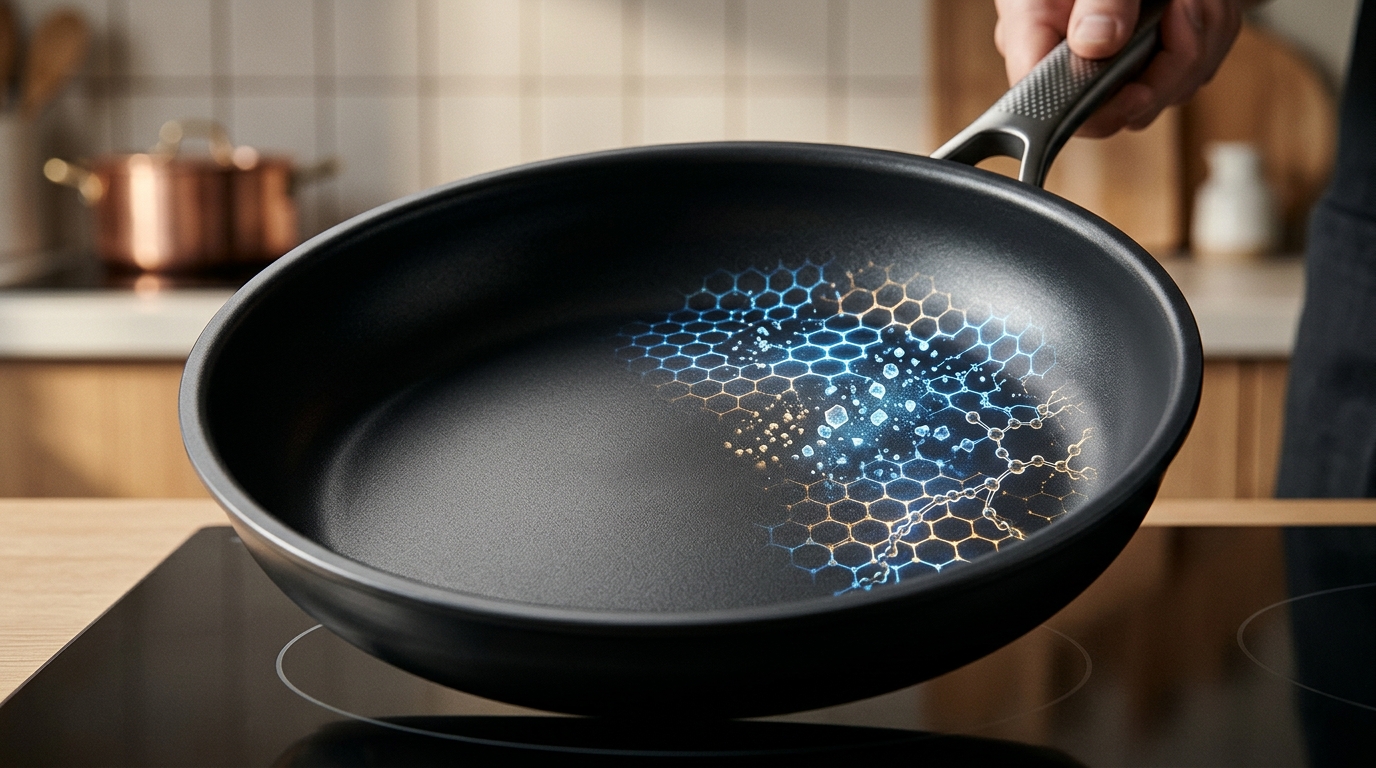
When shopping for high-performance non-stick cookware, consumers inevitably encounter bold claims emblazoned on boxes and marketing copy: “Powered by Japan’s Premium DAIKIN Non-Stick Coating.”
Yet a closer inspection reveals a perplexing paradox:
“Why does an entry-level skillet at a big-box retailer sell for just $15 with a Daikin label, while an imported Japanese Hokuriku Aluminum (HOKUA) pan demands over $80 with the very same Daikin branding? Is the difference truly just marketing hype?”
The answer is an unequivocal no.
While Daikin Industries is an undeniable titan of global fluorochemistry, their culinary coating brand—Silkware—is not a single one-size-fits-all formula. Much like an automotive manufacturer producing both budget compacts and ultra-luxury sedans, the Silkware family comprises a rigorously segmented hierarchy where performance, abrasion tolerance, and lifespan differ drastically.
If you evaluate cookware purely on the brand name “Daikin” without identifying the specific grade code, you risk overpaying for an entry-level formula or expecting years of resilience from a budget pan. Here is the definitive breakdown of the Daikin Silkware family.
1. What is DAIKIN Silkware?
Headquartered in Osaka, Japan, Daikin Industries is globally famous for heating and cooling, but it is equally renowned in chemical engineering as one of the world’s few primary patent holders and innovators of high-grade fluoropolymers (PTFE, PFA, FEP), standing toe-to-toe with DuPont/Chemours.
Daikin branded its proprietary culinary fluororesin solutions “Silkware,” chosen to symbolize “endowing metal cookware surfaces with a silky, friction-free touch coupled with long-term protective endurance.” All authentic Silkware formulations comply rigorously with Japan’s Food Sanitation Act and global food contact standards, offering complete PFOA-free safety, zero toxicity, and exceptional resistance to acidic and alkaline ingredients.
However, “Silkware” is merely the family umbrella. Underneath, Daikin categorizes its solutions into distinct star-rated tiers based on layer architectures (2-Coat vs. 3-Coat), polymer cross-link density, and the integration of reinforcing micro-crystals and spherical ceramics.
2. The Silkware Pyramid: Decoding the Core Tiers
When inspecting cookware packaging or reading the product specification plate, always search for the letter suffix following the Silkware emblem. These letters represent the pan’s durability DNA:
| Grade Code | Market Tier | Coating Construction | Physical Durability & Performance | Representative Applications |
|---|---|---|---|---|
| Silkware EZ | ★★★★★ Flagship Apex | 3-Coat (Three-Bake System) Ultra-dense primer + spherical ceramic / micro-crystalline mid-coat + silk-glide top coat | The crown jewel of Daikin culinary technology. Passed the rigorous Japanese Industrial Standard JIS 2,000,000-cycle abrasion test. Offers extreme scratch resistance and world-class, frictionless oil-free egg release. | Exclusive to premium Japanese cookware (e.g., HOKUA Sencren-Cast FAN) and master-crafted culinary tools. Price: ~$50 – $100+ USD |
| Silkware SD | ★★★★☆+ Dot-Spray Heavy Duty (Textured Specialization) | Proprietary High-Viscosity Dot Spray High-solid fluororesin cured via droplet-spray to form uniform micro-textures | Physical texture disperses friction. Passed JIS 1,000,000-cycle abrasion test. Micro-peaks minimize direct food contact while holding microscopic oil films, delivering elite wok endurance. | Bestselling Japanese deep stir-fry and multi-pans (e.g., Hokuriku Aluminum “Goku-Fukami” series), IH wear-resistant cookware. Price: ~$40 – $75 USD |
| Silkware EX / EH | ★★★★☆ Heavy-Duty Tier | 3-Coat (Three-Bake System) Mid-coat fortified with hardened anti-abrasion particles | Exceptional slip and wear resistance, designed for heavy daily cooking. Excellent resistance to boiling brine and food acids. | Premium domestic pans and boutique Japanese lifestyle brands. Price: ~$35 – $60 USD |
| Silkware ES | ★★★☆☆ Reinforced Mid-Tier | 2-Coat or 3-Coat Specialized high-adhesion and shear-resistant base | Formulated for high-friction cooking environments. Strong peel resistance and solid thermal stability. | Mid-priced woks, electric griddles, multi-cookers, and pressure cooker liners. Price: ~$25 – $40 USD |
| Silkware EK / EL | ★★☆☆☆ Mass Consumer Tier | 2-Coat (Two-Bake System) Standard primer + pure fluororesin top coat | Decent initial food release and non-stick glide, but lacks micro-crystalline reinforcement. Averages 100k–300k abrasion cycles; prone to faster thermal degradation. | Promotional supermarket skillets, budget electric pots, and lightweight bake pans. Price: ~$10 – $25 USD |
3. Why Lifespan Differs by 3x: 3-Coat vs. 2-Coat Micro-Engineering
Many assume non-stick coatings are simply “painted on” in a single layer. In reality, longevity is governed by multi-layer sintering and microscopic barrier engineering:
【Premium 3-Coat Architecture (e.g., Silkware EZ)】
┌───────────────────────────────────────────────┐  Top Coat: High-purity friction-free fluororesin (Silky glide)
├───────────────────────────────────────────────┤  Mid Coat: Hard spherical ceramics & micro-crystals (Scratch armor)
├───────────────────────────────────────────────┤  Primer: High-adhesion chemical bonding layer (Anchored to metal)
================================================= Substrate Metal (Al-Mg Cast Alloy or Clad Composite)-
Depth of Defense in 3-Coat Systems (Silkware EZ): In flagship Silkware EZ, the three distinct layers function synergistically. The ultra-smooth top coat delivers effortless food release. Even when daily cooking causes minor surface wear, the underlying mid-coat—densely packed with microscopic spherical ceramic shields—acts like architectural rebar, absorbing utensil pressure and preventing scratches from propagating down to the base metal. This internal shield is precisely why EZ easily withstands 2 million JIS abrasion cycles.
-
The Fragility of 2-Coat Systems (Silkware EL/EK): By contrast, entry-level Silkware EL and EK omit the central reinforcing layer to minimize manufacturing costs. While silky and effective for the first few months, the unreinforced top coat quickly thins under repeated thermal expansion and cooking friction, leading to premature degradation within 6 to 12 months.
4. The Buyer’s Playbook: 3 Rules to Avoid Cookware Traps
Equipped with this knowledge, apply these three criteria whenever shopping for non-stick cookware:
Rule 1: Look Past Marketing Copy to the Specification Tag
Brands legally using any Daikin resin are permitted to print “Daikin Coating” on front packaging. Always inspect the back specification tag or official import Japanese label for the letters “EZ”, “SD”, “EX”, or “ES”. If the label merely offers a vague “Daikin Fluororesin Coating” with no grade designation, it almost certainly employs entry-level EL or EK.
Rule 2: Premium Coatings Require Heavy-Gauge Cast Substrates
A formula as sophisticated as Silkware EZ is wasted on cheap stamped sheet metal. Japanese master manufacturers like Hokuriku Aluminum (HOKUA) pair Silkware EZ with thick-gauge (3.0mm base) cast aluminum-magnesium alloy bodies in their famous Sencren-Cast FAN line. The thick cast base absorbs thermal shock and diffuses flame hot spots, preventing the pan from exceeding 260°C (500°F)—ensuring the coating delivers 3 to 5+ years of active duty. If you seek a deeper multi-purpose stir-fry pan, HOKUA’s Goku-Fukami series with Silkware SD utilizes dot-spray micro-textures to balance massive capacity with high-heat stir-fry resilience.
Rule 3: Match the Grade to Your Cooking Frequency
- Daily Cook / High-Heat Stir-Frying: Invest directly in Silkware EZ (for ultimate silky glide) or Silkware SD (for textured wok durability). The upfront price pays for itself in years of sustained non-stick performance.
- Casual Weekend Cook (1–2x weekly): A Silkware EX or ES skillet strikes an ideal balance of durability and budget.
- College Dorm / Temporary Rental / Camping: A lightweight Silkware EL or EK pan is more than sufficient for brief stints and simple meals.
5. Best Practices to Maximize Silkware Longevity
Regardless of whether your pan features flagship EZ or mid-tier ES, observing proper care habits preserves fluoropolymer integrity:
- ❌ Never Preheat Dry on High Heat: Empty preheating on high flames rapidly surges past 260°C, causing irreversible polymer degradation.
- ❌ Avoid Thermal Shock: Plunging a scorching pan into cold tap water induces violent metal contraction, pulling the coating away from the primer. Let it cool or wash with warm water.
- ❌ Reserve Shellfish for Steel or Cast Iron: Clams, crabs, and jagged bone cuts can mechanically gouge even reinforced coatings.
- ✔️ Stick to Silicone or Wooden Utensils: While EZ tolerates smooth metal spoons under JIS testing, soft tools guarantee maximum coating life.
- ✔️ Clean with the Soft Side of a Sponge: Mild dish soap and a soft sponge easily dissolve cooking residue on silky Silkware surfaces.
Summary: Demand Flagship Quality for the True Japanese Silk Experience
Daikin Silkware’s celebrated international reputation was forged by top-tier engineering. By demanding the Silkware EZ designation, you bypass vague marketing shortcuts and secure an authentic, featherlight, and exceptionally durable Japanese cooking companion for years to come.
Support Independent Perspectives & In-Depth Insights
Every thoughtful analysis and candid critique comes from our dedication to truth and quality. We choose not to follow sensational algorithms or clickbait headlines.
Sustaining independent research requires reader support. Make a one-time or monthly contribution, securely processed by Google.
Payments secured by Google · Manage or cancel anytime in your Google Account



Comments