
From sizzling garlic-and-basil stir-fries and steaming bowls of ginger-infused clam soup to classic Japanese sake-steamed clams, the hard clam (Meretrix lusoria) has long been celebrated for its tender bite and intoxicating, naturally savory sweetness.
Yet, when planning everyday meals and nutrition goals, home cooks and fitness enthusiasts frequently encounter two common pitfalls:
On one hand, fueled by high-protein or low-carb diet trends, many assume that buying a pound of clams will yield a massive intake of lean protein. On the other hand, the culinary experience is easily ruined by a gritty mouthful of sand, while generational “hacks”—such as dripping sesame oil into the soaking water or tossing in a pair of metal scissors—often leave the clams suffocated, fishy, and flavorless.
What is the actual nutritional profile of clams? How much edible meat do you truly get from a pound of whole, in-shell clams? And how can you leverage bivalve biology to purge every grain of sediment cleanly?
This comprehensive guide breaks down the science of clam nutrition and delivers the ultimate, foolproof sand-purging technique.
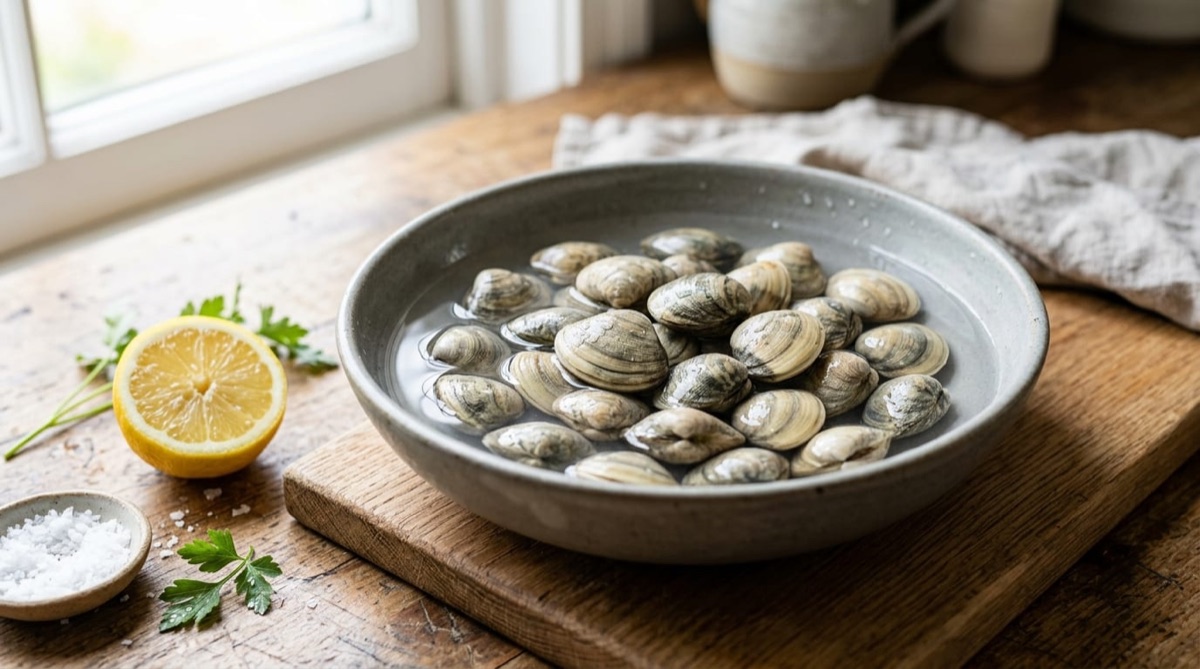
1. The Nutritional Truth: De-Shelling Yield vs. Protein Expectations
When browsing nutritional databases, people often see that raw clam meat contains roughly 7.6 grams of protein per 100 grams. Enthusiastically, they purchase 1 catty / jin (approximately 600 grams or 1.32 lbs) of live clams, anticipating a bountiful intake of over 45 grams of protein in a single sitting.
Unfortunately, this calculation overlooks the most decisive metric in seafood preparation: the edible yield (de-shelling ratio).
Nutritional Profile and Real Intake Breakdown
According to the Food Nutrient Database maintained by the Ministry of Health and Welfare, Republic of China (MOHW), raw shucked hard clam meat provides the following nutritional breakdown:
| Nutrient Metric | Per 100g Shucked Clam Meat | Actual Yield per 600g (1 Catty) In-Shell Clams |
|---|---|---|
| Calories | 37 kcal | ~65–74 kcal |
| Protein | 7.6 g | ~14–15 g (equivalent to ~2 whole eggs) |
| Fat | 0.5 g | ~0.9–1.0 g (ultra-low fat) |
| Iron | 8.2 mg | ~15 mg |
| Vitamin B12 | 50.54 µg | ~90–100 µg |
| Zinc | 1.1 mg | ~2.0 mg |
The Shell Weight Reality: One Catty Equals Just Two Eggs
Hard clam shells are remarkably thick and heavy, accounting for 65% to 70% of the clam’s total gross weight.
When you buy 600 grams of whole, live, in-shell clams from a market, cooking and shelling them leaves you with only about 180 to 200 grams of edible meat.
Consequently, that entire batch yields merely 14 to 15 grams of protein. If your goal is to hit a standard daily target of 60 to 75 grams of protein purely from clams, you would need to devour roughly 4 to 5 catties (over 5 pounds) of whole clams in one go.
From both an economic standpoint and digestive volume, relying on clams as your primary bulk protein staple is neither cost-effective nor practical.
The Real Nutritional Superpower: An Ultra-Low-Fat Micronutrient Arsenal
While clams may not match chicken breast or tofu in total protein volume, their true value lies in an extraordinary concentration of vital micronutrients:
- Near-Zero Fat and Minimal Calories: With just 0.5 grams of fat per 100 grams of meat, a full plate of clams contributes fewer than 75 calories, making it a stellar umami-rich choice during cutting or caloric deficit phases.
- Exceptional Heme Iron: One catty of clams yields roughly 15 mg of bioavailable iron—fulfilling virtually 100% of the daily recommended dietary allowance for adult women, offering strong protective benefits against iron-deficiency anemia.
- Off-the-Charts Vitamin B12: Supplying 90 to 100 µg of Vitamin B12 per 600g batch, clams deliver dozens of times the standard adult daily recommendation (2.4 µg). Vitamin B12 is essential for red blood cell formation, cognitive clarity, and neurological integrity.
- Rich in Zinc and Natural Taurine: Clams deliver bioavailable zinc to support tissue regeneration and immune function, alongside natural taurine, which aids hepatic bile salt conjugation, supports lipid metabolism, and alleviates physiological fatigue.
Strategic Culinary Pairing:
Treat clams as a natural flavor base and micronutrient booster rather than a primary protein filler. Combine them with firm tofu, seabass fillets, chicken breast, or fresh shrimp in broths or steamed platters. The natural succinic acid in clams unlocks vibrant umami, while the accompanying proteins elevate total macro intake without extra fat.
2. How to Purge Clams Completely: The 4-Step Tidal-Environment Method
Few culinary experiences are more disheartening than savoring a plump, steaming clam only to encounter a sharp, sandy crunch.
Sand purging is not a matter of luck or folklore; it is an active biological respiration and filter-feeding process.
In the wild, hard clams inhabit intertidal sandbars and mudflats, burrowed shallowly beneath the seabed. They will only relax, open their valves, and extend their incurrent and excurrent siphons to pump water when their immediate surroundings feel safe, quiet, and familiar.
The universal logic of purging is simple: faithfully reconstruct their native intertidal habitat (accurate salinity, stable ambient temperature, dark stillness, and sufficient oxygen).
Here is the exact 4-step scientific procedure:
Step 1: Formulate a 2.5% to 3.0% Salinity Brine (Salinity Dictates Shell Opening)
Hard clams are marine bivalves highly attuned to osmotic gradients:
- Too fresh (such as plain tap water or weak salt water): The sudden osmotic shock causes clams to seal shut defensively.
- Too salty: Excessive hypertonicity dehydrates their delicate tissues, rapidly killing them.
The Golden Brine Ratio:
- Water: 1,000 ml of room-temperature tap water.
- Salt: 25 to 30 grams of coarse sea salt or fine salt (approximately two level standard Asian soup spoons).
- Thoroughly dissolve the salt completely before introducing the clams.
Step 2: Elevate the Base & Spread in a Single Layer (Prevent Ingesting Expelled Sand)
One of the most frequent mistakes in purging is that clams re-inhale the sand they have just spat out.
- Wide-Bottomed Container: Choose a broad, shallow basin or baking dish and arrange the clams in a single, flat layer. Avoid piling them on top of one another, as heavy stacks cause lower clams to remain tightly clamped shut.
- Elevated Grid / Strainer: Place a steaming rack, colander, or a pair of crisscrossed chopsticks at the bottom of the basin before placing the clams on top. As sediment is expelled, it sinks through the gaps to the true basin floor, completely out of reach of the siphons.
- Calibrated Water Level: Pour the brine so that it just barely covers the top rims of the shells. Excessively deep water creates oxygen-depleted dead zones at the bottom, suffocating the clams.
Step 3: Shield with a Dark Cover and Rest at Room Temperature (Never Refrigerate)
Under tidal sand, clams live in perpetual darkness, keenly sensitive to shadows and kinetic vibrations.
- Darkness Breeds Confidence: Cover the container with a dark cloth, inverted baking sheet, or lid to simulate subterranean burrow conditions. In total darkness, they will promptly extend their siphons.
- Undisturbed Stillness: Keep the basin on a quiet, vibration-free countertop. Refrain from nudging the basin or poking the siphons.
- Cool Ambient Room Temperature (20°C–25°C): Never place the soaking clams in the refrigerator! The cold 4°C temperature shocks clams into metabolic dormancy (torpor), paralyzing their siphon reflexes and completely halting the purging mechanism.
Step 4: Lift Out, Scrub, and Drain (Observe Safe Soaking Durations)
Under optimal conditions, healthy clams will expel over 90% of internal sediment within 2 to 3 hours.
- Lift, Never Dump: When the time is up, gently lift the clams out with your hands or a slotted spoon from top to bottom. Dumping the entire basin through a colander will pour the accumulated sediment back over the shells.
- Rub and Rinse: Rub the clams against one another under running water to scrub away exterior grit and mucus. Drain thoroughly before cooking.
- Strict 4-Hour Time Limit: Do not let clams soak in static water for more than 4 hours. In a confined container, dissolved oxygen depletes rapidly, triggering bacterial proliferation, foul odors, and clam mortality.
3. Sand-Purging Myths Debunked: Stop Suffocating Your Clams
Many kitchen hacks passed down through generations may appear to work fast on the surface, but they compromise meat freshness and introduce food safety hazards.
Myth 1: Does adding sesame oil or vegetable oil speed up purging?
Verdict: Strongly discouraged. It merely suffocates the clams.
Oil is less dense than water and immediately spreads across the surface, creating an impermeable barrier that blocks atmospheric oxygen from dissolving into the water. Dissolved oxygen levels plummet in minutes.
The rapid jetting of water seen when oil is applied is not efficient purging; it is an agonizing, near-death asphyxiation spasm. Under acute oxygen deprivation, clams burn through glycogen and succinic acid, degrading their sweet umami notes. Moreover, stagnant anaerobic oily water encourages rapid bacterial spoilage.
Myth 2: Does tossing in rusty nails, scissors, or iron spoons help?
Verdict: Unnecessary, and introduces heavy metal and sanitary risks.
Old tales of placing iron utensils in the bowl stem from the observation that iron oxidation in saltwater consumes dissolved oxygen. Like the oil trick, it merely induces an oxygen-deprivation panic reflex.
With a precisely measured 2.5%–3.0% saline solution and quiet darkness, clams purge naturally and peacefully. Submerging rusty tools or unsterilized hardware invites chemical residues, rust flakes, and pathogens into your cookware.
Myth 3: Do vacuum-sealed supermarket clams need purging?
Verdict: Yes! A 30-to-60-minute wake-up soak in 3% brine is highly recommended.
Pre-packaged vacuum-sealed clams sold in supermarket chillers undergo preliminary washing at processing facilities before distribution. However, during extended cold-chain transit and shelf display, the clams remain locked in chilled dormancy, frequently retaining microscopic silt and metabolic waste inside their mantles.
Dropping them straight from package to pot often results in a lingering refrigerated musk. Giving them a 30 to 60-minute soak in 3% room-temperature brine revives their metabolism, flushing out lingering sediment and stale odor notes for a far cleaner, sweeter finish.
Conclusion: Let Science Elevate Your Seafood
While clams are not a high-yield protein substitute for lean meats, their matchless concentration of bioavailable iron, zinc, and vitamin B12 makes them an indispensable nutritional gem in a balanced diet.
By respecting their biology with the four foundational pillars—2.5%–3.0% salinity, elevated single layering, shaded stillness, and room-temperature rest—you can banish sandy bites forever and unlock the purest, plumpest umami your kitchen has to offer!
Support Independent Perspectives & In-Depth Insights
Every thoughtful analysis and candid critique comes from our dedication to truth and quality. We choose not to follow sensational algorithms or clickbait headlines.
Sustaining independent research requires reader support. Make a one-time or monthly contribution, securely processed by Google.
Payments secured by Google · Manage or cancel anytime in your Google Account



Comments