
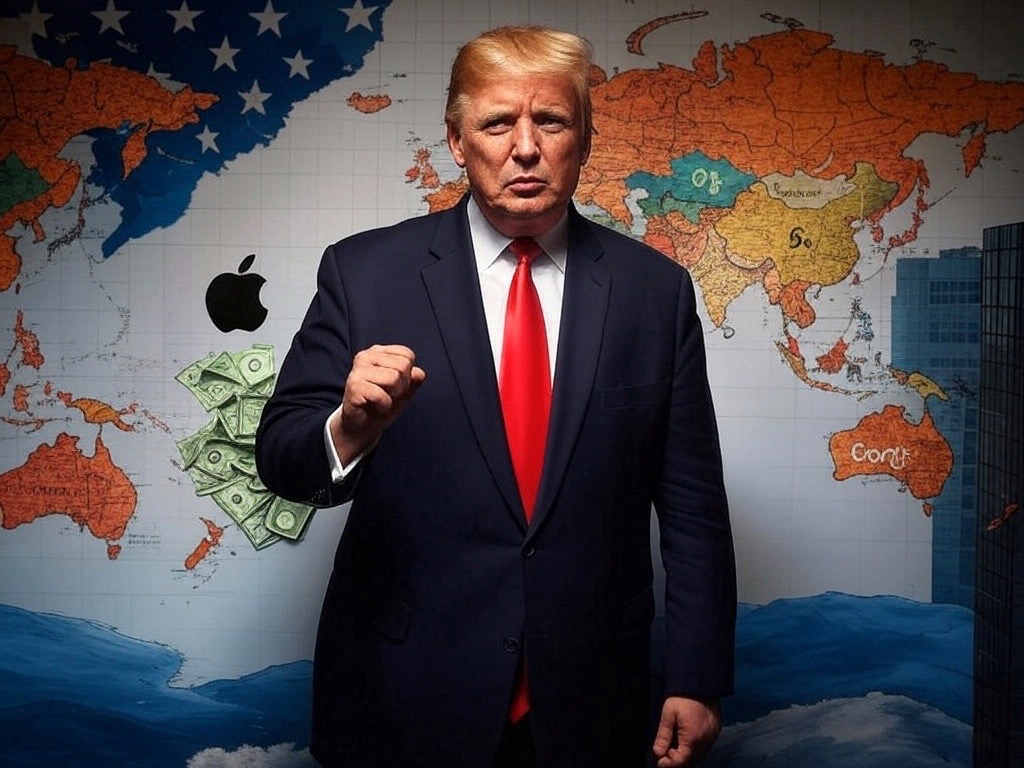
U.S. President Donald Trump recently announced new tariffs on goods from multiple countries, claiming that the move is “not about retaliation or punishment, but about creating a fairer world.” This statement has sparked widespread debate, particularly amid the looming shadow of a global trade war, with many questioning the true intent behind this policy.
At the same time, a more pointed issue has emerged: Why does Trump’s tariff hammer consistently spare the massive profits that American tech giants reap in the global market—particularly in the digital economy? From the Apple Store’s app revenue cuts to Netflix’s subscription empire and Google Adsense’s advertising dominance, these tech behemoths not only extract capital from around the world but also stifle the survival of businesses in other countries, exposing the double standards in Trump’s “fairness” narrative.
This article delves into the logic of Trump’s tariff policy, the predatory practices of tech giants, and the broader economic and political implications.
Trump’s Tariff Logic: A Veil for Fairness?
Since returning to the White House in early 2025, Trump has swiftly fulfilled campaign promises by imposing tariffs ranging from 10% to 50% on goods from approximately 60 countries, with rates on Chinese products reaching as high as 60%. He has publicly stated that these tariffs aim to correct “unfair trade practices,” protect American manufacturing, and boost domestic employment. On the surface, this policy aligns with Trump’s longstanding “America First” stance, attempting to force companies to relocate production back to the U.S. by increasing the cost of imported goods.
However, the actual impact of tariffs is far from straightforward “protectionism.” For physical goods, import tariffs directly drive up consumer prices—from iPhone components to appliances and clothing—leaving American consumers to bear the brunt of the added costs. In stark contrast, the excessive profits of U.S. tech companies in the digital economy remain untouched by any policy challenges. These companies, through globalized digital platforms, generate profits far surpassing those of traditional manufacturing, yet they are not held accountable for the same “fairness” Trump champions. Even more troubling, their business models not only extract capital globally but also suppress the survival of businesses in other countries. This raises a critical question: What standard of “fairness” is Trump actually pursuing?
Tech Giants’ Excessive Profits: Predatory Digital Economies and Stifled Global Competition
To understand this double standard, we must first examine how U.S. tech giants extract excessive profits in the digital economy while hindering the survival of businesses in other nations. Using Apple, Netflix, and Google Adsense as examples, their business models not only rely heavily on global markets but also exploit tax loopholes, market dominance, and uneven regulatory environments, creating a chokehold on global competitors.
- Apple Store’s App Revenue Cuts and Monopolistic Suppression
Apple charges a 30% “Apple Tax” on app developers through its App Store, a rate considered exorbitant in the digital economy. Billions of iPhone users worldwide pay for apps and in-app purchases, with a significant portion of that revenue flowing directly into Apple’s coffers. While this income is generated globally, Apple uses subsidiaries in low-tax countries like Ireland to shift profits to tax havens, paying minimal taxes in the U.S. More critically, the App Store’s monopolistic position leaves small and medium-sized developers with little choice but to comply, a practice criticized as exploitative of the global innovation ecosystem. For app developers in other countries, Apple’s dominance means not only high costs but also restricted competitiveness in the global market. For instance, local app developers in emerging markets often cannot afford the steep revenue cuts, leading to their exclusion from the market and eventual elimination by U.S.-based apps. - Netflix’s Subscription Empire and Cultural Domination
Netflix, a global streaming giant, collects steady cash flows from subscriptions in over 190 countries and regions. While its content production costs are substantial, the subscription fees from global users enable Netflix to maintain high profit margins. Like Apple, Netflix also uses cross-border tax arrangements to shift profits to low-tax regions, minimizing its tax contributions to the U.S. government. Notably, Netflix’s pricing strategy does not significantly adjust for the economic disparities across countries, meaning users in developing nations often pay disproportionately high fees for the same service. Furthermore, Netflix’s global expansion poses a significant threat to local film and television industries in other countries. Many developing nations’ media companies, constrained by limited funding and technology, struggle to compete with Netflix, resulting in a severe reduction of space for local cultural content. This has led to accusations of “cultural colonialism,” as Netflix’s dominance marginalizes local voices. - Google Adsense’s Advertising Hegemony and Market Exclusion
Google dominates the global digital advertising market through Adsense and its broader ad ecosystem. From small websites to YouTube creators, countless content providers rely on Google’s ad revenue sharing to survive, but Google extracts a high percentage of the profits in the process. More alarmingly, Google leverages its algorithms and data advantages to prioritize high-profit ads, squeezing creators’ earnings and forcing advertisers to pay higher rates in bidding wars. This model, amplified globally, delivers a devastating blow to local advertising platforms in other countries. For example, many advertising firms in emerging markets cannot compete with Google’s technology and scale, leading to closures or acquisitions, which in turn stifles the development of local digital economies.
A common thread among these tech giants is that their profits stem not from traditional physical goods trade but from digital services and platform economies. The globalized nature of this business model allows them to bypass many countries’ regulatory and tax frameworks while enjoying relatively lenient policies in the U.S. More critically, their market dominance not only extracts capital globally but also suppresses the survival and growth of businesses in other nations. Trump’s tariff policy focuses on physical goods imports, yet turns a blind eye to the predatory practices and suppression of global competition by these digital giants. Does this indicate a selective approach to policymaking?
The Root of Double Standards: A Complex Political and Economic Game
To explain why Trump’s tariff policy overlooks the excessive profits of tech giants and their suppression of global competition, we must analyze the issue from both political and economic perspectives.
- Political Considerations: The Influence of Tech Giants
American tech companies wield immense economic and political influence both domestically and internationally. Companies like Apple and Google are not only pillars of the U.S. stock market but also exert influence over policymaking through lobbying groups. While Trump is known for his “anti-establishment” persona, his administration cannot entirely ignore the interests of these corporations. For instance, Apple CEO Tim Cook has engaged in direct discussions with Trump multiple times, securing certain exemptions or buffers for the company on tariff issues. Additionally, the tech industry’s creation of high-paying jobs and its image of innovation make any harsh policies targeting them politically risky. - Economic Structure: The Unique Nature of the Digital Economy
Unlike traditional manufacturing, the digital economy’s profits primarily come from intangible assets (such as software, data, and branding), which are difficult to regulate through conventional tariffs. Even if Trump intended to impose higher taxes on tech giants, the implementation would face technical and legal challenges. For example, the Digital Services Tax, which has been trialed in regions like the EU, has met resistance from the U.S. government, which argues that it undermines American companies’ competitiveness. Trump’s tariff policy opts for a simpler path—targeting physical goods rather than the complexities of digital transactions. - Ideological Bias: Prioritizing Manufacturing
Trump’s economic vision has always centered on revitalizing American manufacturing, aligning with the demands of his voter base—blue-collar workers and the middle class. In contrast, the tech industry’s profits are largely concentrated among coastal elites, creating a potential conflict with Trump’s populist stance. For him, penalizing foreign imports is more politically appealing and easier to showcase as a “win” to voters than challenging domestic tech giants.
Global Perspective: The International Fallout of Double Standards
Trump’s tariff policy has not only sparked controversy domestically but also provoked strong reactions internationally. Many countries criticize the U.S. for attempting to reshape global trade rules through tariffs while ignoring the market dominance and predatory practices of its tech giants. For instance, the EU has in recent years issued hefty antitrust fines to companies like Apple and Google and sought to regulate their profit-shifting through Digital Services Taxes. In contrast, the U.S. government’s stance appears far more lenient, frustrating allies and trade partners.
More alarmingly, the predatory practices of U.S. tech giants are exacerbating global economic inequality. Local businesses in developing countries, unable to compete with these giants, see their survival space increasingly squeezed. For example, local streaming platforms and advertising firms in Southeast Asia can hardly rival Netflix and Google, leading to capital and talent flowing toward American companies and further weakening local economic autonomy. This phenomenon has been dubbed “digital colonialism” by some scholars, describing how U.S. tech firms establish a new form of economic hegemony through technological and capital dominance on a global scale.
Ironically, Trump’s tariff policy may indirectly amplify the dominance of tech giants. As tariffs drive up the cost of physical goods, consumers may redirect their spending toward digital services, such as subscribing to Netflix or purchasing in-app services. This means tech giants not only remain unscathed by tariffs but may even profit from them.
Conclusion: The Illusion of Fairness and the Reality of Contradictions
Trump claims his tariff policy aims to create a “fairer world,” but his silence on the excessive profits of U.S. tech giants and their suppression of global competitors reveals the limitations of this narrative. The business models of platforms like the Apple Store, Netflix, and Google Adsense have indeed sparked global debates about fairness and market dominance, as they not only extract capital worldwide but also hinder the survival and growth of businesses in other countries. However, the operational logic of these digital giants differs vastly from physical goods trade, making traditional tariff tools ill-suited to address the issue. That said, this does not mean policymakers can entirely ignore the inequalities in the digital economy.
True fairness may require a more comprehensive perspective—one that not only focuses on trade balances in manufacturing but also confronts the concentration of power, profit distribution, and the destruction of global competitive ecosystems in the digital economy. Trump’s tariff policy may buy some breathing room for American manufacturing in the short term, but if it continues to ignore the predatory practices of tech giants and their impact on businesses in other nations, the so-called “fairness” will remain an empty slogan. Moving forward, both the U.S. and the global community must find a more balanced regulatory framework between the physical and digital economies to achieve a true win-win for trade and innovation.
發佈留言