
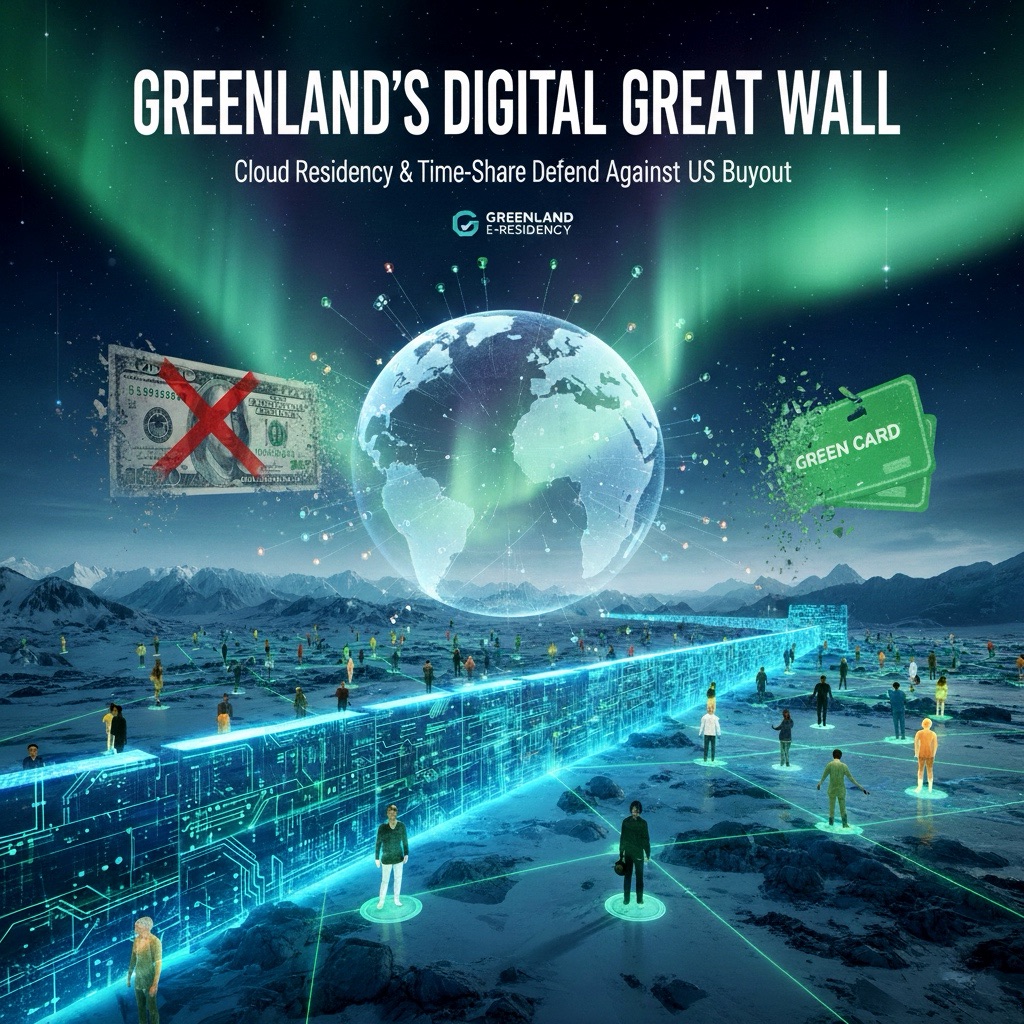
In the shifting geopolitical landscape of 2026, Greenland has once again become the ultimate prize for global superpowers.
In the eyes of the Trump administration, Greenland is a “real estate deal” waiting to happen.
The logic is simple: with a population of only 57,000, a direct compensation of $100,000 per person would cost the U.S. government a mere $5.7 billion—a pittance compared to the cost of a single aircraft carrier.
However, Greenland can neutralize this threat by launching a decentralized “Digital Sovereignty Revolution,” transforming its small population into a massive legal and financial “poison pill” that no superpower could afford to swallow.
The “Budget Black Hole”: Scaling Compensation to Infinitude
The core of the U.S. acquisition strategy relies on the low cost of buying out a small population. Greenland’s counter-move is to immediately launch a global “Cloud Residency” program.
- Artificial Population Surge: By opening online applications for digital citizenship with a nominal fee, Greenland could realistically scale its legal “population” from 57,000 to 5 million or even 10 million global citizens within months.
- Financial Paralyzation: If the U.S. attempts to buy out the residents, it would no longer face a small town, but a global army of legal claimants. At $100,000 per person, a population of 5 million would drive the acquisition cost to $500 billion. This astronomical figure would immediately trigger a fiscal crisis in the U.S. Congress, making the “deal” dead on arrival.
The “Green Card Bomb”: A Legal Nuclear Strike
Annexing territory involves more than just buying land; it involves absorbing its people. Greenland can create a legal minefield by linking digital residency to physical infrastructure.
- Registered Physical Addresses: The Greenlandic government can designate public buildings, research stations, or automated modular housing as the “legal registered address” for all cloud citizens.
- The Immigration Trap: Under U.S. legal precedent and international norms of territorial succession, if the U.S. annexes Greenland, the millions of legally registered residents on that land would have a powerful legal claim to U.S. Green Cards or citizenship.
- Political Suicide: For any U.S. administration, the prospect of being forced to grant millions of Green Cards overnight to people from all over the world is a non-starter. This “Green Card Bomb” would shatter the domestic U.S. immigration system, making annexation a political impossibility.
Time-Sharing Residency: Solidifying the Physical Link
To prevent the international community from dismissing cloud citizens as “ghost accounts,” Greenland would implement a “Time-Sharing Residency” system.
- Physical Footprint: Cloud citizens would be granted a 7-to-14-day annual physical stay in state-provided modular housing.
- Global Stakeholders: This turns millions of global elites into “shareholders” of Greenlandic sovereignty. When millions of people from different nations have physical assets, registered businesses, and residency rights in Greenland, any attempt at annexation becomes a global conflict rather than a local land grab.
Conclusion
This strategy shifts the battle from military or economic pressure to legal and fiscal asymmetric warfare.
By making the cost of annexation include a $500 billion deficit and a multi-million Green Card crisis, Greenland ensures its sovereignty.
It is no longer an isolated island in the Arctic; it is a decentralized, globalized “Digital Fortress” that the world’s largest superpower simply cannot afford to buy.