
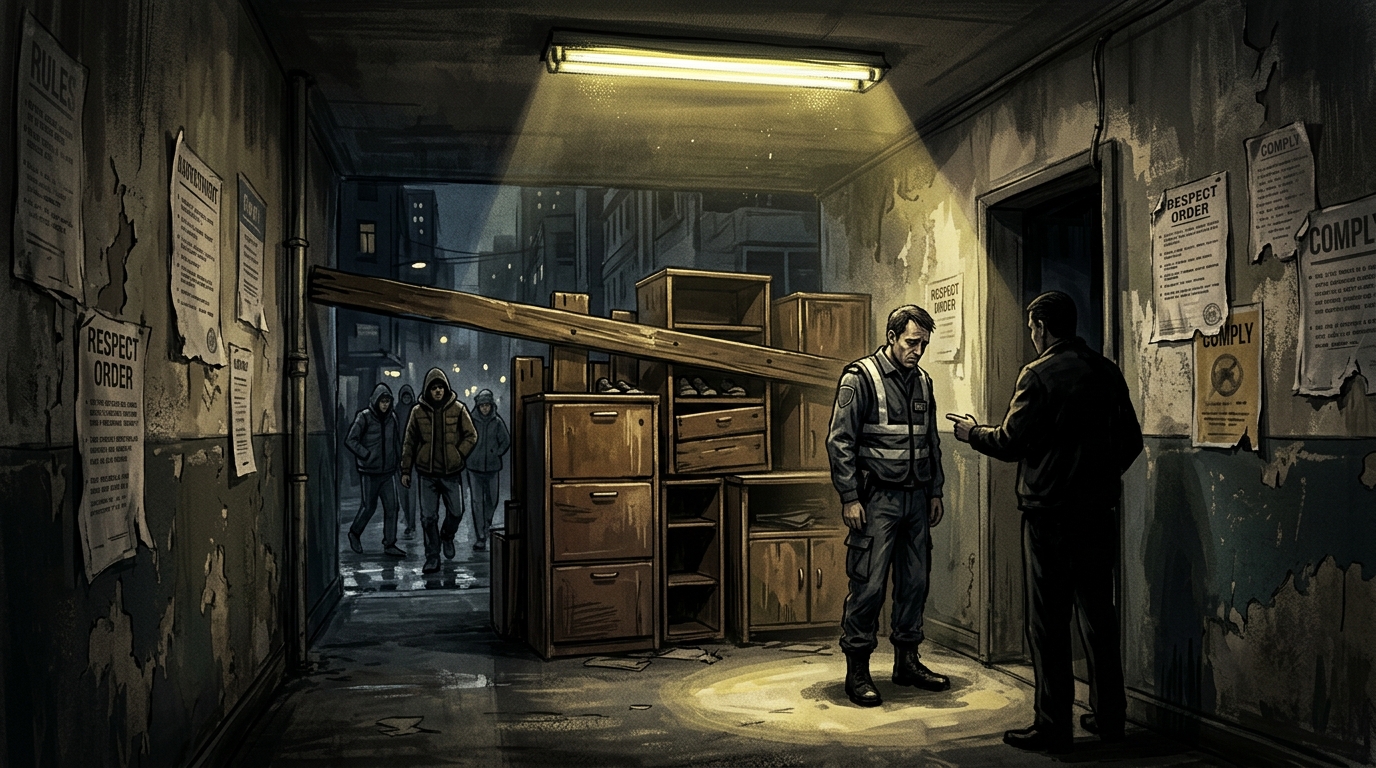
Picture your apartment community. Posted on the hallway wall in black and white: “Hallways must remain unobstructed. Personal storage strictly prohibited.” For a long time, residents complied. Then one day, a resident wedges a massive shoe cabinet right at the elevator vestibule. A dutiful new security guard writes a formal warning notice. The resident storms into the management office, slams desks, threatens to leak complaints to the press, and rallies neighbors to oust the committee chairman.
The building chairman does not remove the encroaching cabinet. He reprimands the guard.
A notice is promptly posted: The rule remains officially in effect, and everyone is urged to practice “civic virtue and moral self-discipline.” However, to preserve communal harmony, guards are forbidden from issuing further warnings. To appease the offender, the guard is issued an official disciplinary reprimand for “unprofessional demeanor and inciting tension.”
The written rule remains framed on the wall—a purely decorative artifact. To eliminate inconvenience, the system decided to eliminate the person maintaining order.
Schrödinger’s Red Line and the Sacrificed Watchdog
This microscopic absurdity mirrors modern governance and societal operations with chilling accuracy.
Consider traffic laws. The legislature enacts clear fines for illegal parking to protect pedestrian safety and maintain flow. When new enforcement rolls out, frontline officers issue citations and citizen reporting mechanisms operate as intended. Predictably, habitual offenders revolt. They besiege elected officials, flood petition hotlines, and shout that they were “just grabbing takeout for five minutes” or that enforcement is “predatory money-grabbing.”
Administrative leadership reacts precisely like that timid residential chairman.
The statute is not formally repealed. Instead, informal directives trickle down: “Overlook minor infractions,” “prioritize persuasion over citations,” and “avoid public backlash at all costs.” Officers who persist in their duties face closed-door rebukes and deflated performance reviews. When confrontations arise on the street, high-ranking officials rush to apologize for “tactless enforcement” rather than providing backing.
This constitutes a structural betrayal. The state draws red lines and demands that frontline workers defend them, only to shoot them in the back when pressure mounts.
Rules derive their efficacy entirely from enforceable coercive power. When an authority decrees that “the rule exists, but sanctions are forbidden,” the law is practically dead. It is no longer a standard; it is a toothless wishing well.
Compliance costs and violation costs are fundamentally inverted. The offender pays nothing, extracting real benefits from breaking rules while invoking “reason and empathy.” Meanwhile, frontline workers gamble their careers and dignity just to keep the machinery functioning. The system’s immune system begins consuming itself—penalizing the white blood cells while permitting viral proliferation.
”Self-Discipline” as an Entitled Fig Leaf
“Moral self-discipline” sounds virtuous. But when brandished by offenders, it becomes an immunity card for social entitlement.
Why do authorities so readily make such schizophrenic decisions—loudly proclaiming the rule while castrating enforcement? The answer is purely pragmatic: bilateral political hedging.
Retaining the rule absolves leadership of legal responsibility. As long as the statute exists on paper, officials can point to the books whenever catastrophe strikes. When an industrial accident or fatal traffic collision occurs, administrators shrug and insist: “Prohibitions were clearly established; this was an isolated individual lapse, not a systemic failure.”
Forbidding punishment, conversely, pacifies loud troublemakers. Enforcement provokes friction, protests, media leaks, and lost votes. For decision-makers, eliminating the enforcement action instantly eliminates the visible backlash.
If nobody is fined, nobody protests. If nobody protests, the illusion of harmony is preserved.
In environmental protection and labor compliance, this dynamic is even more brazen. Chronic labor law violators or polluting factories face impending penalties from honest inspectors. Business lobbyists immediately lobby: “The government shouldn’t treat enterprises like criminals; excessive fines kill growth. Give us room to self-regulate through Corporate Social Responsibility.”
This rhetoric assumes that shame alone governs human conduct. In reality, those who shout loudest about “self-discipline” are often those with the lowest moral thresholds. What they seek is not discipline, but consequence-free impunity. Because morality cannot be quantified or audited, retreating into vague ethics grants violators endless room for maneuver.
This represents the total triumph of social infantilism: demanding the benefits of public infrastructure while rejecting the burdens of communal restraint.
Without objective standards or enforceable costs, rules become an asymmetrical tax on the conscientious. Honest citizens who pay parking meters and businesses that invest heavily in compliance watch violators flourish unscathed. Why uphold rules that the system itself refuses to defend?
Scapegoating the Whistleblower: Truncated Scapegoating
Customer complaints have been weaponized into asymmetric warfare.
When caught, habitual violators rarely concede wrongdoing. Sensing organizational vulnerabilities, they mobilize political connections, post selective video clips online, and file endless administrative grievances alleging “harassment” or “lack of empathy.”
This tactic thrives because leadership instinctively opts for truncated scapegoating.
Faced with cameras or legislative inquiries, administrators fear political damage above all. To staunch the bleeding, they offer the cheapest sacrifice possible: severing the frontline worker like a lizard’s tail.
Don’t resolve the violation—resolve the disciplinary action that caused the commotion.
A tax officer auditing a politically connected entity is reassigned for “disrupting citizens.” An environmental auditor penalizing illegal discharge is ordered to withdraw the citation to avoid “stifling regional economic vitality.” Bureaucracies invent Orwellian labels to punish conscientious staff: poor communication, rigid mindset, lack of consensus.
Officials perform a public pantomime of humility, claiming they “listen to the people.” The statute remains pristine in the law books. Violators walk away with granted privileges.
Only the faithful frontline worker is nailed to the cross.
Societal Consequences: Systemic Disengagement and the Sucker’s Burden
How do penalized, demoted, and silenced frontline workers behave the next morning?
They adapt rationally.
Do more, make more mistakes; do less, make fewer; do nothing, stay safe. This is not bureaucratic laziness; it is evolutionary survival under hostile incentives. When diligence is punished and negligence rewarded, any rational agent looks the other way.
The inevitable outcome is comprehensive frontline disengagement.
Officers overlook illegal parking. Safety inspectors gloss over falsified logs. Teachers turn away from classroom bullies. Regulators stamp approval on questionable plant reports. It is not that they lack professional ethics; the system has taught them through painful precedent that taking duty seriously makes you a casualty.
And who pays the ultimate price in this grand theater of false peace?
The law-abiding majority who complied from day one.
Conscientious citizens pay taxes, wait in queues, and shoulder regulatory burdens, only to watch scofflaws monopolize public spaces, externalize pollution, and berate civil servants with impunity. Gresham’s law takes over: bad behavior expels good.
Honest citizens inevitably realize that following rules has become an act of self-harm. You walk your child into moving traffic because sidewalks are blocked by vehicles; your compliant business loses contracts to illegal competitors dumping waste directly into streams.
When you complain, authorities regurgitate hollow platitudes: “We are raising public awareness and urging everyone to exercise moral self-discipline.”
When discipline becomes an alibi for state dereliction, the social contract disintegrates. Honest people are left with two choices: either join the scofflaws in cannibalizing social trust, or disengage entirely into cynical apathy. Either path marks the quiet death of civil society.
Contemporary Diagnosis: Sepsis in the Body Politic
Institutional decay begins when internal immune responses are forcibly deactivated.
From micro-level building disputes to national administrative retreats, the logic is identical. Trading frontline integrity for temporary public relations peace is an injection of bureaucratic morphine. Pain fades instantly, but necrosis spreads beneath the skin.
An organism that systematically punishes its white blood cells will inevitably perish from sepsis.
We must see through the rhetoric. Loud appeals to personal morality are the unmistakable signature of bankrupt enforcement. Morality is an aspirational ceiling; law and regulation are the structural floor. Pretending the baseline is a voluntary virtue confesses systemic failure.
When institutions turn their weapons upon their own sentries, do not rely on hollow appeals to self-discipline. Prepare instead for the brutal realities of the jungle.
Support Independent Perspectives & In-Depth Insights
Every thoughtful analysis and candid critique comes from our dedication to truth and quality. We choose not to follow sensational algorithms or clickbait headlines.
Sustaining independent research requires reader support. Make a one-time or monthly contribution, securely processed by Google.
Payments secured by Google · Manage or cancel anytime in your Google Account




Comments